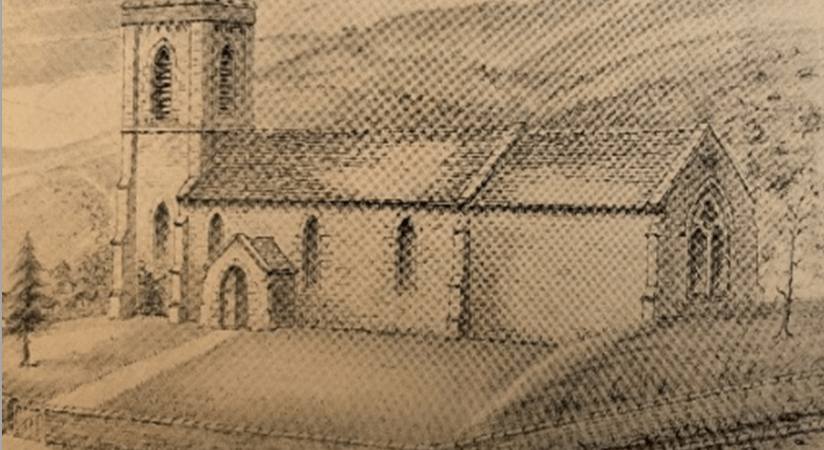
The forest of Saddleworth was at the time (1215) a bleak and wooded upland with swampy valleys and a sparse hillside population occupied with sheep and cattle farms of Saxon origin. William de Stapleton granted tithes (one tenth of annual produce or earnings, formerly taken as a tax for the support of the Church and clergy) to St Chad’s of Rochdale for his chapel.
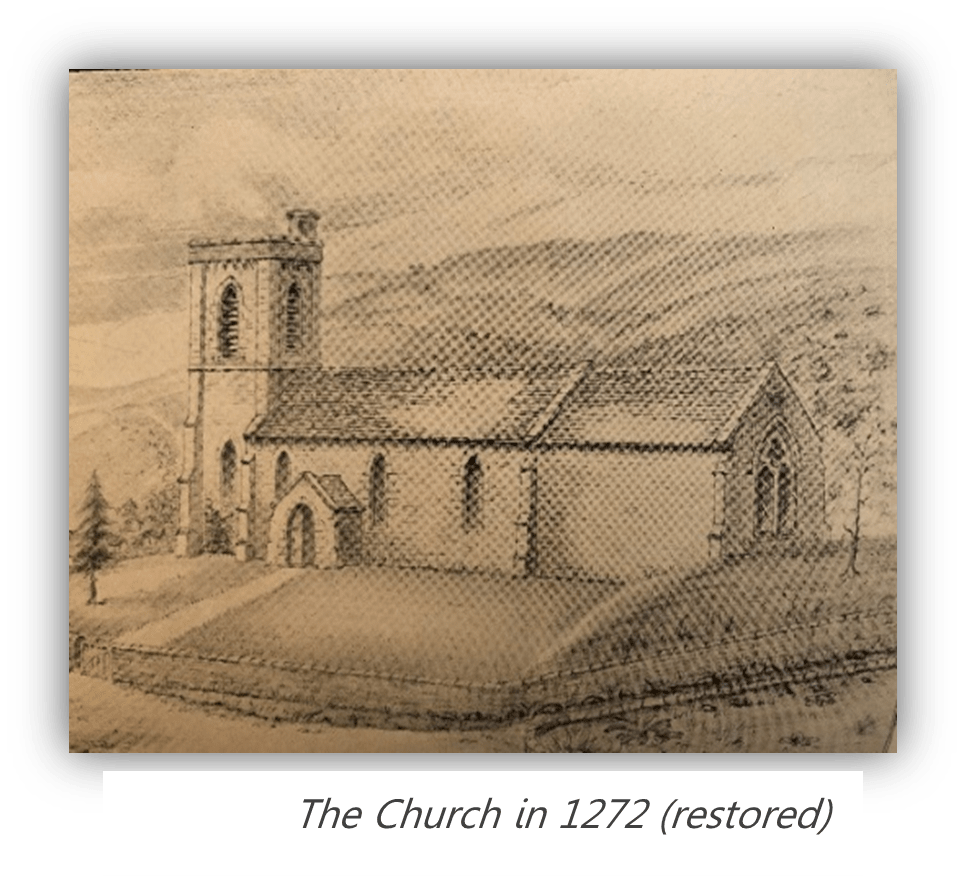
The Church dedicated to St Chad took 60 years to build, passing to his son in 1271, Robert de Stapleton. This Church stood for 600 years.
In 1335 as recorded in the Coucher Book of Whalley Abbey a record of Bishop of Lichfield compelled the Convent under obligation to repair the chancel roof, which had been allowed to become ruinous.
About, 1530, larger windows were inserted to the North and South walls. The mullioned windows being good examples of the style at that time. At the end of the 16th century the church was considerably enlarged by taking down the south wall, building an arcade of 3 arches with pillars and erecting a south aisle and porch. The 2 Tudor windows were brought forward and built in the new wall in similar positions.
The dissolution of the Monasteries that followed the 1536 Act of Parliament and when Whalley Abbey ceased to be, Rochdale became independent and patronage of Saddleworth passed to it.
It was in the year of 1642 (when war commenced in Nottingham) documented in registers at the time held in 1915 by Mr Morgan Brierley, that the people of Saddleworth declared their ‘protestation of their resolve to maintain the religion against’ a backdrop of political and royal confusion as parliament took arms and civil war ensued. The protestors were numerous and aged over 18 years
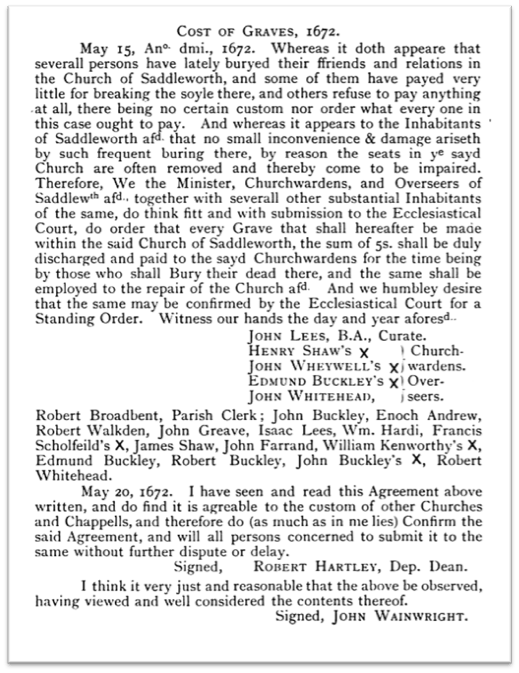
May 1672 it was decided that the method of contributing to the cost of burying was not equitable and approval was gained so that the Church could fix the cost to 5s.
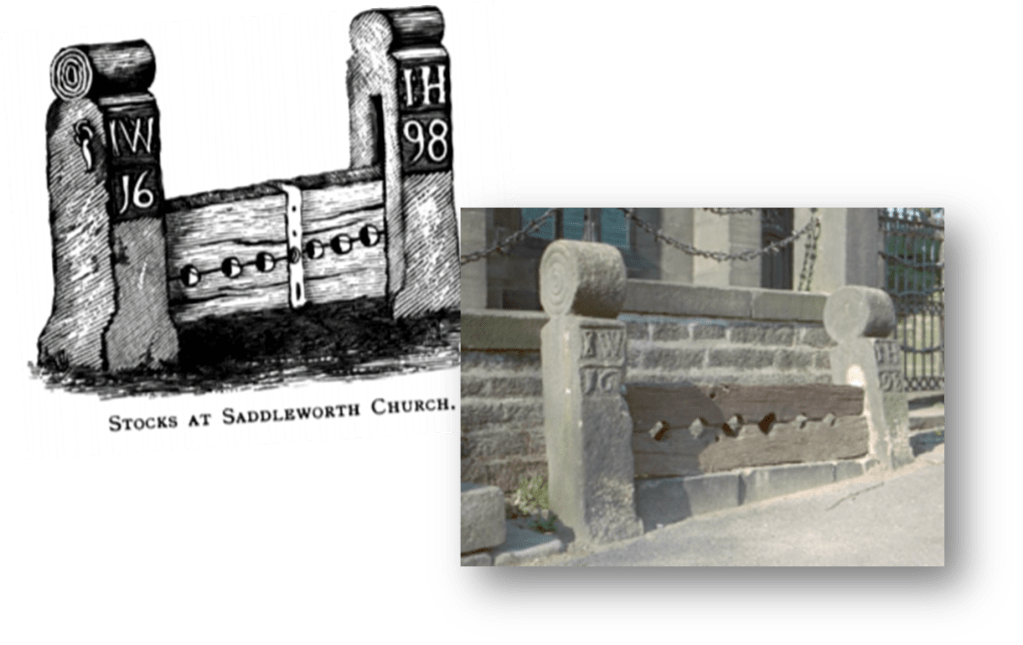
In 1698 the Stocks (separately listed grade 2), inscribed with the date, were set up in front of the old church, probably replacing an older set. Originally instituted by Edward 3rd in 1350 for the punishment of serious offences. Later, they were used for Sabbath breakers and drunkards. The timber foot restraints have been replaced and each post has a cylindrical-shaped head with concentric circles carved on the outer faces. A drawing shows them to be in good condition in 1891
 Historic Saddleworth Church