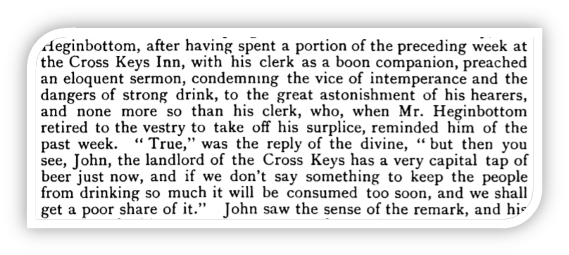
1721 an extract from the Parish Register, provides an insight to the character of Mr John Heginbottom. He was incumbent for 50 years. Died on the 19th January 1771 aged 76 years old. The stone now enclosed within the new Church in the south aisle.
Our records indicate that Rev John Heginbottom is buried inside church, (image not available). He is buried with his daughter Elizabeth, aged 22, a Clerk, bur’ 5th January 1744, another daughter named Lucy aged 14, bur’ 10th September 1751, and his wife Martha aged 73, a clerk, who lived on Platt Lane bur’ 21st December 1770.
An article in the Huddersfield Chronicle (West Yorkshire) Issue 487, printed Saturday 16th July 1859, Notabilities of Saddleworth, by a young Mountaineer discusses the passing of Mr William Heginbottom a great proficient in music aged 91 years, died at Ox-hey, in Saddleworth 8th December 1817. Who was the Son of the late Rev John Heginbottom, who was many years an eminent, zealous and pious minister at the Parish Church. He was interred by torch light on the evening 12th December 1817 at St Thomas’s Chapel, Friar Mere. Amongst his numerous grandsons may be mentioned Mr Broadbent, the poet.
Extract from Supplement to Saddleworth Parish Registers – list of persons having held the living of Saddleworth pp 534 – 539 edited by John Radcliffe 1891
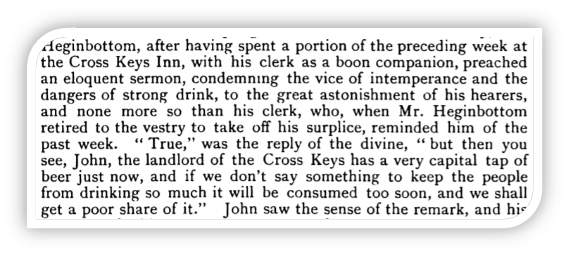
Born at, or near Mottram, in Longendale, June 4, 1965. Was educated at Manchester Grammar School, from whence he proceeded to Brasenose College, Oxford. B.A., 15 Oct., 1716; M.A., 1721. He was nominated to the living by the Rev. Henry Pigott, Vicar of Rochdale, and licensed by Francis Gastrill, Bishop of Chester, 1721. He lived at the old Parsonage House, which he either enlarged or adapted it for the use of his family. He had a numerous family of sons and daughters and their descendants still survive. When Mr. Pigott gave him the Living, he observed to him -“Mr. Heginbottom, the Saddleworth people are a very turbulent and unmannerly set; what will you do with them?” He replied- “Preach the Gospel, and if that will not do” – clenching his fists and throwing himself into a Boxing attitude- “this will!” On one occasion a sturdy Farmer insulted him, and observed in reply to some remark of Mr. Heginbottom’s- “It is only your Gown that protects you;” on which Mr. Heginbottom said, throwin it off-“Indeed! that shall be no protection; I am your man!” His sermon preached before Samuel Peploe, Bishop of Chester, in Manchester Collegiate Church [now the Cathedral,] is still spoken of in Saddleworth, certainly after the lapse of three generations, with high high commendation. Many anecdotes are still current of his achievements during the ascendancy of his inebriating potations, and are somewhat remarkable. On one occasion, it is reported that, being at an Episcopal Visitation held in Manchester, Mr. Heginbottom had tarried longer than was convenient, even for his robust frame, over the sparkling wine, or the still more favourite punch. The Bishop had long heard strange reports and obscure allusions to the favourite amusements of this celebrated Divine, but “he was not hackneyed in the ways of (such) men” as Mr. Heginbottom, and hardly received the testimony borne against him. However, his Lordship was now assured that this mountain Pastor was quite overcome with “strong drink,” and was the subject of considerable merriment in Manchester. The good Prelate (most likely Dr. Peploe), not being disposed to wield St. Peter’s sword, sent to two or three Clergymen to inform Mr. Heginbottom that his Lordship requested he would preach the following morning at ten o’clock in the Collegiate Church, before himself and his clergy. This announcement greatly discomposed our Reformed Pastor, who had no alternative, but felt convinced that he must either preach to the confusion of his enemies, or otherwise come under ecclesiastical censure. He retired to rest for a few hours, and afterwards arose and wrote the chief part of a sermon, which occupied him a considerable portion of the night. At the appointed time Mr. Heginbottom appeared robed and ready in the pulpit. In a composed manner he surveyed his audience, and fixing his piercing eye on the Clergy who had waited on him the preceding day, and knowing them to be the Bishop’s spies, he gave out his text in a firm, sonorous voice, the 42nd chap. Geneisi, 16v.- “By the life of Pharoah, surely ye are spies” – to the no small inconvenience of the Reverend informants, who received a castigation which they never afterwards forgot. The Bishop pronounced a high encomium upon the sermon, and doubted whether he had a Clergyman in the Deanery who could write so able a discourse on so short a notice; of course his Lordship said nothing respecting the occasion. Mr. Heginbottom was frequently the companion and guest of old Collier (Tim Bobbin), the author of the “Lancashire Dialect;” and on one occasion, after a riotous and tumultuous evening spent at Milnrow, in which blows, broken glasses, and indecently opprobrious words were eminently conspicuous. Mr. Heginbottom preached for his friend, Mr. Haigh, * at Milnrow Chapel, and Collier and others of the festive board” were present, desirous of hearing what the Saddleworth Parson would say in the pulpit/ He selected Nehemiah xiii.25v. as his text – “And I contended with them and cursed them, and smote certain of them and plucked off their hair, and made them swear by God, saying, Ye shall not give your daughters unto their sons, nor take their daughters unto your sons, or for yourselves.” The sermon is stated to have been as pungent as the text. One Sunday, Mr. Heginbottom, after having spent a portion of the preceding week at the Cross Keys Inn, with his clerk as a boon companion, preached an eloquent sermon, condemning the the vice of intemperance and the dangers of strong drink, to the great astonishment of his hearers, and none more so than his clerk, who, when Mr. Heginbottom retired to the vestry to take off his surplice, reminded him of the past week. “True,” was the reply of the divine, “but then you see, John, the landlord of the Cross Keys has a very capital tap of beer just now, and if we don’t say something to keep the people from drinking so much it will be consumed too soon, and we shall get a poor share of it.” John saw the sense of the remark, and his reverence for his master was more profound than ever. In a MS. in Trinity Church, Coventry, dated 1462, is the following among the Offices of a Deacon:- “Itm, he schalle helpe to sarve at ev’y drenking after ev’ry derege don at ye cost of ye Church.” “Itm, ye sayd dekyn & hys felow schale helpe ye Churchwardens to cover ye Awter and ye rode in lente wt lentyn clothys & to hyng ye vayleing equere, and ye Churchwd’ns schale gyff them money to drynke.” I can well believe that our thirsty Parson of Saddleworth would have been truly happy to be sent to Coventry.
Mr Heginbottom was must esteemed by the opulent family of Farrer, of Bamborough Grange, the Lord of the Manor of Saddleworth, and had many valuable presents of books sent from old Mr. John Farrer. His grandson and successor, when a young man, visited his estates in Saddleworth, an on the Sunday attended Divine worship at the Church. Mr Heginbottom ascended the pulpit, looked inquiringly round his congregation, then at Mr. Farrer’s pew in the west gallery, then gave out the chapter and verse, and waited a moment or two, castin a fierce look at the young Squire, and at length said, “This is the heir: come, let us kill him, and the inheritance shall be ours!” Probably Mr. Farrer had expressed some fears as to his personal safety on coming amongst persons who, even at this day, are said by some to be uncivilised, and one degree removed from barbarians!
Notwithstanding his irregularities, he was not indifferent to the duties of his Parish, but was always ready, when in his better moments. to visit the sick, and to baptise infants, and these deeds of mercy were often done. He was accompanied in these pastoral visits by a venerable white pony and a large dog. He was much beloved by his flock, and during his time there was not a dissenter in Saddleworth. He generally farmed the Glebe himself, and it is reported that on a Sunday evening in the harvest his congregation would accompany him from the Church and assist him gratuitously to bear home on sledges his hay, carts and waggons being then unknown in Saddleworth. He always had a good cask of beer before this period arrived, and the more grave part of the labourers indulged themselves with copious potations. After the toils of harvest, “the owd Parson” assembled his children and young neighbours, who amused themselves by dancing upon the Parsonage Green, whilst he animated their evolutions by gay and cheerful airs upon his well-worn fiddle. He perhaps would have said, with the poet, as he amused his haymakers after service: – The rich man’s close-shut windows hide the concerns of the quality; The poor can but spare A crack’d fiddle in the air, which offends all sound morality.
The following is an extract from a mutilated sermon by the Rev. John Heginbottom, at Saddleworth Church A.D. 1751. Although boast is not excluded, yet the preacher appears to have done the work of an evangelist. He refers to the state of his parish in morals and religious knowledge when he first became the Incumbent, and his sermon must have sounded somewhat egotistical, at least to his younger hearers. The diction and orthography is preserved. “When I first became yr lawful Pastor (wch is now above 30 years ago), such gross ignorance I met wth in some Persons in this chapelry, and such indecency and un-uniformity I observ’d in ye Behaviour of others in the Public Worship of God, that I dearly lamented the same, and made it my Business in familiar and gentle manner often to instruct the former and reduce the latter to decency, uniformity, and good order in ye Service of God, wch most of this Congreation is now remarkable for. And that I might lay a foundation of the Xn Knowledge among you, have I not labour’d more abundantly that many of my Brethren in Catechising yr Children, Servants, and Apprentces? Have I not duly visited many that have been sick among you wh I might lawfully have refused by reason of their Distemper being infectious? Have I not, in Sermons suited to your exigencies and Capacities of my Auditors, endeavour’d to settle ’em in an Orthodox and sound ffaith, and a Practice conformable thereto, by unfolding ye great Duties and Doctrines of Xty, by reclaiming the Vicious, instructing ye ignorant, persuading those in ye right Way to persevere therein, and those that have erred and are deceiv’d to return into the way of Truth; in a word, by instruction, by rebuking and administ’ring to ’em the means of Grace, and watching for their Souls as on yr must give An account.” The conclusion of the sermon is as follows:- “But, on the other Hand, to do all good Offices to those yt are Dedicated to the Service of ye Altar is is one proper Method to Procure God’s Blessing upon Us here (as is evident from Mal.iii.10-11), and also to increase our Reward hereafter; because he yt encourageth and enableth a Prophet for his Duty, has an int’rest in his Work, and consequently in the Reward that belongs to it. He that receives a Prophet in ye name of a Prophet (i.e. out of respect for his Function) shall receive a Prophet’s Reward. – Matt.x.41. I cannot tell what thoughts many of you may now entertain of ys Discourse I’ve deliver’d to you, or what effect at present it may have upon you; but when ye come to lye languishing upon yr Death-Beds, and seriously reflect on ye Duty to yr Minister, and yr Practice that has been directly contrary to it (how that instead of esteeming him very highly in love you have despis’d and vilified him, instead of praying for him curs’d him, instead of contributing cheerfully accordg to yr abilities towards his maintainance have communicated to him little or nothing). I never question but yr consciences (if they be not sear’d) will miserably howl and rave agst you, and prove little less than Hell to you. Be persuaded yn for the sake of God’s Glory, the Peace of yr own Minds here, and ye Everlasting Felicity hereafter, to render to all their Dues, tribute to whom tribute is due, custom to whom custom, fear to who fear, honour to whom honour, and that you may never want either will or power to do it. I shall conclude with the following prayer.”
He was musical and encouraged Psalmody in the Church. The use he made of his fiddle after service on the Lord’s Day would not have been distasteful to King James, and Mr. Heginbottom would doubtless have defended the famous “Book of Sports.” He was unable to officiate in the Church for some years before his death, owing to total blindness; but he regularly attended the services of the Church, and, from a high desk erected behind the pulpit, pronounced the Blessing after his Curate. In his declining years he became more regular in his habits, and was more respected by his parishioners. He died at the house of one of his children, at Platt Lane, near Dobcross, and was buried on the 19th January, 1771, in the 76th year of his age, near the chancel door without the Church**. His wife, Martha, a very kindly-disposed and worthy woman, died at Platt Lane, Dec.21, 1770, aged 73 years. He had been half a century Incumbent of Saddleworth, with an income of little more than £50 per annum, and a small sum subscribed by some of the parishioners. Mr. Heginbottom was in the habit of going in person round his parish to receive the “subscriptions” and the first call was invariably at Grotton Head. Old Madam Buckley (such was her designation) was a woman of frugal habits, but generally liberal to the Church, and frequently had the Minister of Saddleworth received substantial proof of her Christian love. On one occasion, however, the opulent lady, desirous of ascertaining the humility, or rather extent of humility, of her pastor, volunteered a small piece of silver as her annual gift. This was deemed an intolerable insult by him, who had forgotten that “the Servant of the Lord should be gentle,” and his language to this “teacher in Israel” who was thus exercising her lay episcopacy was far from being indicative of a mortified and chastened spirit. His surprise and mortification were equally great when old Madam Buckley opened her hand and displayed the guineas which have been bestowed had the irritable Minister shown a more becoming temper under is trial. With all his failings, and they were not few, it was said that Dissent was driven by him out of his Parish, and that he was general favourite with his Parishioners. He had an angry Correspondence with the Revd Dr Wray, Vicar of Rochdale, regarding the rights of the Mother Church, and seems to have contended for the independence of the Parochial Chapelry of Saddleworth. Some of Dr Wray’s letters, addressed to Mr. Heginbottom, are copied in Lanc. MSS., vol. 1, pp. 267-272, at Chetham Library; and it was currently reported in Saddleworth that, notwithstanding Dr. Wray’s opposition to the doughty incumbent, and his disapproval of much in his life and character, the good Vicar did not neglect him in old age and poverty; but his compassion was moved at “the hard battle” which the poor servant of God had fought. He did quietly and by stealth, and Mr. Heginbottom never knew who his benefactor was.
*(Joseph Haigh, Curate of Milnrow, was one of the congenial parsons of Mr. Heginbottom’s time. The following anecdote is told of him:- One Sunday, when in the pulpit, he heard the shouts of a party of otter hunters, and seeing that this congregation began to leave the Chapel, he whispered to his clerk, “I say, James, they have caught her- she vents- let us go! Now to God the Father,” &c-Raines’ MS., vol. xxxviia,.p.344.
** This stone is now enclosed within the new Church, in the south aisle.
Extract from History of the Chapelry and Church of Saddleworth and the Township of Quick (1915) by Alfred J Howcroft
pp69
In Mr. Heginbottom there was a clerical champion for the independence of Saddleworth (1721 to 1771). He was a thorn in the flesh to Dr. Wray, Vicar of Rochdale, while he lived, and at his death it was revived with increased vehemence when the parishioners repudiated Rochdale and claimed again their right to nominate Mr. Stone, the Curate under Mr Heginbottom, who continued to officiate for six years but was not given the Incumbency. After the parishioners had resorted to lawyers and caveats and violent language the Vicar won. Mr Stones was appointed to Rawdon, near Leeds, and Revd. Richard Podmore, LL.B., was appointed successor to Mr. Heginbottom.
pp157-158
Mr. John Heginbottom, curate in 1721, was a noted individual, about whom there are many stories. He lived at the old Parsonage, probably the last incumbent who did so. A good preacher, of strong personal character, which may be gathered from his dealings with Dr. Wray, Vicar of Rochdale, who entered into a long dispute with him as to the independence of Saddleworth. His habits became lax and many of his parishioners shunned him. It is said at harvest time he would persuade his congregation after service to assist him in getting in his crops, after which he provided a cask of beer and the company danced while fiddled.
 Historic Saddleworth Church