
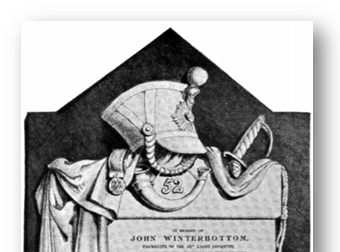
An article in the Huddersfield Chronicle (West Yorkshire) Issue 487, printed Saturday 16th July 1859, Notabilities of Saddleworth, by a young Mountaineer mentions the Paymaster as being thrice enlisted into the army, having been twice ransomed or ‘bought off’. References the monument to his memory. A large white marble tablet found in church.
A sketch was presented with a printed list in London, January 1839. Many officers who had served in the 52nd Light Infantry were desirous of recording their respects. An account was open at Messrs Cox and Co, where subscribers could pay one Sovereign to afford this memorial. A surplus remained from the subscription and it was used to produce a lithographic sketch with copies delivered to the subscribers.
The parish register goes on to record the character of this gentleman and soldier indicating that due to the insanitary conditions of the officers quarters in St Anne’s Barracks, Barbados, twelve of the officers were attacked by the yellow fever, and three died, one of who was Paymaster John Winterbottom.
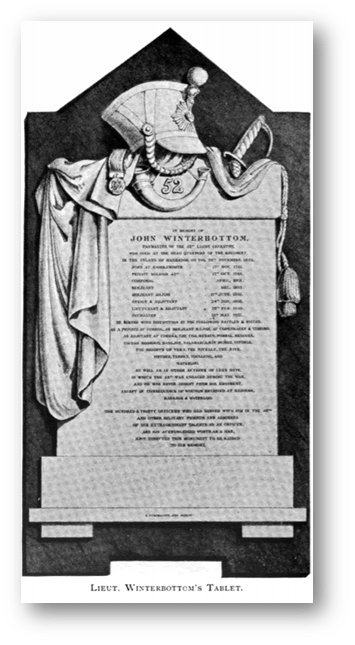
Inscription
In Memory of
John Winterbottom
Paymaster of the 52nd Light Infantry
Who died at the headquarters of the regiment
In the Island of Barbadoes on the 26th November 1838
Born at Saddleworth 17th Nov 1781
Private Soldier 52nd 17th Oct 1799
Corporal April 1801
Sergeant Dec 1803
Serjeant Major 11th June 1805
Ensign & Adjutant 24th Nov 1808
Lieutenant and Adjutant 28th Feb 1810
Paymaster 31st May 1821
He served with distinction at the following battles and sieges;
As a private at Ferrol
As a sergeant major at Copenhagen & Vimeiro
As adjutant at Corunna, the Coa, Busaco, Pombal, Redinha, Ciudad Rodrigo, Badajoz,, the Nive, Orthez, Tarbes, Toulouse and Waterloo
As well as in other actions of less note in which he was never absent from his regiment except in consequence of wounds received at Redinha, Badojoz and Waterloo. One hundred and thirty officers who had served with him in the 52nd and other military friends and admirers of his extraordinary talents as an officer, and his acknowledged worth as a man, have directed this monument to be raised to his memory
.R Westacott Sculpt.
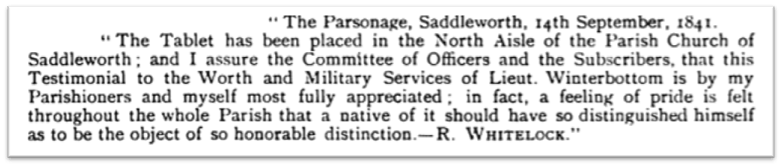
Lily Hopkinson writes
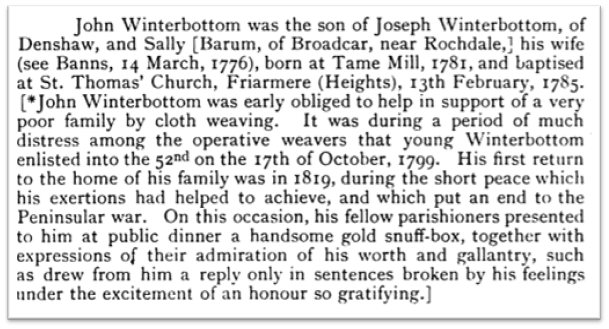
JOHN WINTERBOTTOM was the son of Joseph and Sally Winterbottom in 1781 and baptised at St.Thomas, Friarmere (Heights Chapel) in 1785. The Winterbottoms were a poor family and young John worked as a weaver to support them. It was during a period of distress in the woollen trade that John enlisted into the 52nd Light Infantry in October 1799, aged 18.
His first return to his family was in 1819 (20 years after leaving) by which time he had risen to Lieutenant and Adjutant of the Regiment. Whilst at home a public dinner was organised for him at which he was presented with a gold snuff box, inscribed –
Presented to Lt.Winterbottom, 52nd Regnt., by his fellow parishioners the inhabitants of Saddleworth, in token of their Esteem for his Character as a Man, admiration of his Gallantry as a Soldier.
Parvum mumus quidam sed magnum testator amorem
An extract from The History of Lord Seaton’s Regiment (the 52nd Light Infantry) at Waterloo etc., by Rev.William Leeke, M.A. published 1866, says –
“With the names of Sir John Moore and Lord Seaton, that of Winterbottom ought to be always remembered by his regiment and country as one of the most distinguished soldiers of his day.”
The following is an extract from the book “Passages in the Early Military Life of General Sir George T. Napier, K.C.B” written by himself.
“John Winterbottom was one of the clearest headed, coolest, and bravest men I ever saw in action, and the best adjutant in the army, either in the orderly room or the field; he has served through the whole of the Peninsular War and was sorely wounded several times; he was also badly wounded at Waterloo.
I must tell you a trait of him that does honour to his head and heart. His parents were, as you may suppose, cottagers, and from the moment he enlisted and left them he always sent them a part of his pay and when the war was over and he came home as an officer with a sum of money which he had saved, having had some prize money, the first thing he did was to go and see his aged parents, build them a cottage and garden and allow them a sufficient yearly sum of money to enable them to live comfortably and keep a servant girl to attend upon them.”
John married Miss Winslow of Fredericton, New Brunswick, N. America.
Lt. Winterbottom died at the Headquarters of the Regiment at St. Anne’s Barracks, Barbados on 26th November, 1838, along with 2 other officers who succumbed to Yellow Fever.
 Historic Saddleworth Church