
Written by Jeff Brannan
Based on information provided by A. J. Howcroft (“History of the Chapelry and Church of Saddleworth and the Township of Quick’) prior to 1781 the church had only three bells and these were probably the ones referred to in the agreement of 1272 where the “habentes” were said to have bells with a tower.
In 1746 a new tower was built and the three old bells were re-hung in the new tower.
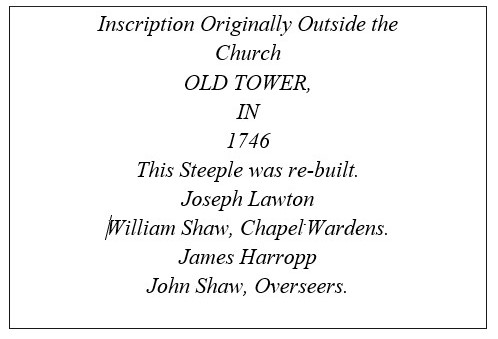
In 1781, the year of John Wesley’s visit to Saddleworth, a new peal of 6 bells were provided. These were cast by Thomas Rudhall of Gloucester and hung by Joseph Wrigley of Manchester. The new bells were inaugurated on 5th November, 1781.
These bells were soon put to good use:-
On Sunday 11th November the Oldham ringers rang a “peal” of 720 changes in 27 minutes.
On 14th November “Prize Ringing” took place with prizes totaling £6-6-0 (6 guineas) being rung for. The Ashton ringers took 1st place on this occasion.
In spite of the fact that, from 1781, Saddleworth possessed a peal of bells capable of being rung to a full peal, the emphasis in those days was to participate in Prize Ringing, possibly as a means of supplementing the ringers’ income!
An alternative ringing activity was for “full peals” to be rung. These are peals where over 5000 changes are rung, often involving up to 3 hours or more of continuous ringing.
Records of these early peals are difficult to trace, often only being mentioned in newspaper articles. The earliest Saddleworth peal record we are currently aware of is a peal rung on Wednesday 6th December 1826 and we have no further records until 1846. Based on our knowledge of the ringers living in Saddleworth we assume there are many other peal records still to be found.
The ringers who took part in the 1826 peal were:-
- John Buckley
- Martin Holding
- John Holding (Snr)
- William Holding
- John Holding (Jnr) James Platt
As this peal was rung in 7 different methods it is quite clear that the Saddleworth ringers at that time were quite advanced and very capable ringers.
The next record we have is of a peal rung on Monday 23rd February 1846 as a farewell peal to the old tower having a note:- “The tower is to be raised about 10 yards, and the bells and part of the tower will be taken down immediately”
For the next 30 or so years we only have records of 6 more full peals which were rung on Saddleworth bells, the emphasis still being on “Prize Ringing” — something now frowned upon!
For the next 30 or so years we only have records of 6 more full peals which were rung on Saddleworth bells, the emphasis still being on “Prize Ringing” — something now frowned upon!
A decision was taken in 1881 to attempt to augment the bells to a ring of 8. During 1882 and 1883 great efforts were made to raise funds for this and, finally, during late1883 to early 1884 the funds became available and the bells were re-hung by Mears & Stainbank of London. At the same time 2 new treble bells (1 & 2) were cast by Mears & Stainbank to augment the ring from 6 to 8 bells, thus opening up new horizons for change ringing at Saddleworth.
The final ringing on the 6 bells before the work commenced was on Wednesday 23rd January, 1884.
The first full peal to be rung on the 8 bells was on 15th March, 1884 was completed by the following team of ringers:
- John J. Brierley
- John Holden
- Franklin Brierley
- James Wrigley
- Edgar Buckley
- Joseph Wood
- Thomas Whitehead
- Edward Wood
INSCRIPTIONS ON THE BELLS
- (Treble) “O Christ, the King of Heaven, may the sound be pleasing to Thee”
- “Ring out the false, ring in the true”
- “Fear God and honour the King”
- “Peace and good neighbourhood’
- “Prosperity to this Parish”
- “Thomas Rudhall Gloucester Foundry”
- Surrounded by a scrollwork and the date 1781
- (Tenor) “I to the Church the living call: and to the grave do summon all’
The Peal is cast in the Key of G, and the weight of the large bell is 12cwt.Bells 3 to 8 (originally 1 to 6 of the ring of 6 bells) were cast by Thomas Rudhall Gloucester and hung in 1781 and. 1 and 2 were cast in 1883 by Mears & Stainbank, London.
The bells were put to very good use with no less than 5 full peals being rung in the first 2 months after re-hanging.
From 1897 things go very quiet on the Saddleworth tower bell ringing front, but it looks as if some of the older ringers were no longer very active, with some of them passing away.
No peals were rung at Saddleworth from February 1897 to August 1918 and by then few of the older Saddleworth ringers were able to take part.
From 1918 to 1931 was again a period with no peal ringing activity. The fact that the bells again had to be re-hung in 1931 may be part of the explanation. In 1931 the bells were removed from the tower and taken to the foundry for turning and re-tuning by John Taylor & Co; of Loughborough. At this time the cannons would no doubt have been removed from the bells so that modern fittings with cast-iron headstocks could be used.
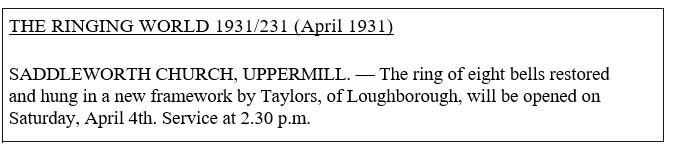
Removing the cannons and re-tuning the bells reduced the weight of the tenor from a claimed 12 cwt to its current weight of 10 cwt 1 qrt 6 lb, with a similar, proportional, reduction in the weight of the other 7 bells.
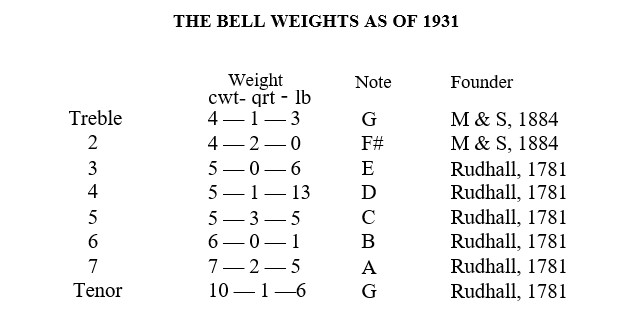
THE RINGING WORLD 1931/247 (April 1931)
RESTORATION WORK AT SADDLE WORTH.
BELLS IN A ‘NO-MAN’S-LAND’ GIVEN NEW LIFE.
Saddleworth, a place famous in the days that are no more and an arena for former six-bell contests, was the scene of renewed activity on Saturday, April 4th, when the restoration of the bells was celebrated in traditional style. The special service was very well attended, and the Rural Dean of Oldham, Canon A. R. Mackintosh, duly dedicated the bells at a service conducted by the Vicar, the Rev. W. Hudson.
Despite the uncertain weather and the position of the church, many visitors, including Mr. J. P. Fidler, of Loughborough, joined with the Saddleworth men in the pleasures of the day and enjoyed themselves to the ‘full’.
The bells are a peal of eight, tenor weighing approximately 11 cwt. The back six were cast by Rudhall in 1781, and these were augmented by two trebles by Mears in 1884. A wonderful transformation has taken place in their tonal effect and carrying power, the falseness in tune having been corrected by the ‘Taylor’ system of tuning. The old timber frame was built in two levels, and for many years made strenuous efforts to make its escape from the tower when the bells wore rung. At last its wishes have been realised, but it made a most ignominious descent from the tower; whether by design or accident, it remained in the churchyard to witness the triumphant entry of its successor, a monster of iron and steel, which now sits snugly in the tower, fitting it like a glove and all on one level. At the call of the bells the new frame acts as the true gentleman it is, so that the former, resplendent in their new rig out, can show off at their best without any unnecessary coaxing. To ring in the tower is now a treat, the handling of the bells is ‘it’ and their sound in the ringing chamber is ideal—two combinations which make for nice `tapping’—and some of the six-bell ‘stuff’ demonstrated this in no mean manner.
The Church authorities deserve every praise for the manner in which they have tackled this restoration, for, despite heavy financial burdens in other directions, they bravely set their shoulders to the wheel and made a job of it. We believe that Mr Burridge, one of the wardens, greatly interested himself in the bell scheme, and has been a tower of strength towards its fulfilment. Great thanks are due to him and all those who assisted in attaining such a splendid result. The proof of the pudding is in the eating of it, and there is no doubt that Taylors have done this job ‘to a turn’ and those who ring at Saddleworth can do so to their hearts’ content.
The original Church of Saddleworth was founded in 1200 by William de Stapleton, who made it subordinate to the mother church of St. Chad, Rochdale, but of this nothing now remains, the present building being a comparatively modern structure, while the tower was rebuilt some time during the middle of last century.
To reach the church, one must first get to Uppermill, which can be reached either by train or bus, then a nice long climb awaits the pilgrim. Like many churches in this locality, that of Saddleworth stands on an eminence on the western slopes of the Pennines, placed well away from the village, which, although it is in the county of Yorkshire, is very close to the borders of Lancashire, Cheshire and Derbyshire, thus making it a sort of no-man’s-land. Yet it retains the grand virtue of hospitality. A large portion of the surrounding country is in a barren state and mountainous, which makes it a favourite spot with ‘hikers’ The industrial part of the district is well away from the church, and thus, in its immediate vicinity, the population is very sparse, and on this further comment is unnecessary.
Despite this out-of-the-way situation, the visitor is well catered for, as there is a very good ‘rest house’ quite handy. Here the visiting ringers were entertained in a most excellent manner, and between thirty and forty did ample justice to a `gradely’ meat tea. ‘Hey by gum, it were champion and cost nowt!’ The very best thanks of all the ringers who attended are due to the good people of Saddleworth for the excellent fare provided, and for the manner in which they received the visitors. To Mr. Jonathan Pilling and his merry men we extend our very best wishes, and trust they will have very many years’ enjoyment with the bells of Saddleworth
The bells again underwent a thorough overhaul in 2006 at a cost close to £9,000, but on this occasion the work was completed without the bells themselves having to be removed from the tower. Only the pulleys and clappers had to be taken to the foundry for refurbishment.
 Historic Saddleworth Church