

Submitted by Judith Liversidge
The search begins for the plot of a gentleman called Ernest Schofield an old friend of Judith’s father Dennis. He can be found in the top left corner of Gelfield Churchyard. Thats the new new yard near to the carpark next to the Parish Cemetary.
‘He used to catch the bus with a Goat’ said Judith, and there begins the story. Judith, showed me some resources, that she has collected over time so that the story of Ernest can be retold.

An extract from Trevor Butterworth’s Recollections of a wartime childhood in Greenfield 1940s, tells us something more about Ernest.
From here to the scrub fields of this western boundary to the valley soared up past the old Ladcastle Road as it meandered its way to Dobcross, and curved on up high to the summit of Wharmton. The hill, scarred by the busy quarry, stood as a backdrop to life in our avenue. From the point bordering Beech Avenue, where the decaying wooden gate knelt open at the side of the ditch, Carr Lane was accessible only for pedestrians and Ernest Schofield’s open trap – and of course his horses and cattle.
Bordered only on one side by hawthorns, the lane wound around the side wall and tiny garden of Ernest (Schofield) o’Darby’s farm. Ernest used to tether his sheep dog in the garden as an effective discouragement from picking the cherries that grew against the house wall.
The lane wound around the farmhouse, skirting the massive old stone steps up the outside of the farm, and twisted back on track, to wander through the gently undulating meadows, past the dip down to Dickie-Bird Hop, through the white gate, then on by the Manse and the first of the houses marking the outskirts of Uppermill.
There were four gates on that stretch of Carr Lane throuhg the fields when I was a lad; two of them wooden and two of them of iron rails, hung from iron hinges set into great stones, with stiles. On these, were two stones at one side set in a gentle V with a slanted gap between the two; one stone set against the boundary, and the other acted as a gate post. There was just sufficient room for a portly chap to scrape his waistcoat against while sqeezing through.
Ernest o’Darby was our provider of milk, delivered from churns on the horse drawn float. He and Minnie, and their farmhand Dennis tolerated our ‘help’ at harvest time as we trailed behind the hired temporary farm hands who were scything and raking and stooking the hay, or later when it was dried, pitch forking it onto the hay cart, or building a hayrick. Great fun, under the watchful eye of adults careful to keep us from accidents inherent in play around such work, and rewarded with a share in the grub and lemonade provided.
I was often allowed to help Dennis milk the cows in the shippon, and i can recall the sweetly smell and rough feel of the cows belly against my cheek as I and the cow leaned hard against one another, me striving to wheedle milk from each teat in turn on the udder, the cow more interested in munching straw and attempting to flick me away with its encrusted tail.
I recall the satisfaction I felt as at last I got the knack; the cheery ring of each stroke as the milk jetted into the pail, and the pain of getting in the way of an impatient kick. I remember too the mischievous squirts caught full face from Dennis milking at the other stall. The pails were poured into a vast wooden tub, which stood outside against the back wall of the farm in a big stone trough full of running water that rose at a spring in the field across the road from the farm. As the milk cooled, the top of the tub was blanketed with inches of thich, rich cream.
The spring which emerged from the Top Field paused briefly in a makeshift pool before swamping the meadow below it, and dribbling continuously across the lane into the yard, making it all a permanent manury dabble to negotiate; and the wild barking of the dog which would rush to snap at the heels of the human animals passing by.
Each time he encoutered us youngsters, Ernest, with his boots and gaiters, warm checked shirt and waistcoat and jacket, head topped with an old brown Derby at a jaunty angle, would hold his stick daintily before him and dance a jig for us. He always had the time of day for us children; it was Minnie who would be the one to reason with our parents when we had over stepped the mark on their land, as we did!
What a beautiful recollection of the area before the inevitable march of time and house building.
Another extract (Source unknown) written December 1980, Greenfield characters of the 1920’s recalls, meeting Ernest for the first time when, his brother and he, used to wander the area, his brother Norman insisting they climb each unusual tree that the encountered. One particular day they heard a voice from below.
“Now then, you’d best comm’ done and let me have a look at yoh’.” The epitome of bravery as usual, Norman just shouted down, “Nowe”, but when the voice replied, “Well then, ah’d best get mi’ gun,” even he wilted and decided that in fact we must descend…finally landing at the feet of the man with rosy cheeks, who by this time was convulsed with laughter.
He was so pleased that he had won the battle without much trouble, that he began asking whose lads we were.
On replying that Oliver Ashton was our dad, (Norman thought that would frighten him, but it didn’t), he said, “Well that’s o’reet then, ah sarve yer mother wi’ milk, be off wi’ yoh, an dunnot tread my gress down again.”
By this time the reader will have gathered that Ernest-o-Darby’s was indeed a farmer of the old school, and that the lands we had trod as conquerers was his meadow land.
Looking back over half a century, he was right, I strongly object to my labours being ruined by thoughtless children.
During the years that ensued, we came to know and love him, and to realise that during the encounter in the meadow we had unknowingly stumbled across one of Saddleworths dearest characters.
Ernest used to wear a bowler hat and red waistcoat when he went out in his pony and trap, shouting out his greetings to all that knew him.
He was never one liked to work hard, or tackle some difficult or arduous task, no, he would find someone else to do that, but he was always there with his advice.
He managed throughout his life, previous to our knowledge of him, to avoid women, but even he fell to their wiles, and eventually married a lady called Minnie who surprisingly enough made him more docile than he had ever been. He used to attend all the local fairs, revel in adulation that was showered on him by all and sundry. When walking about the farm he always had a collie dog at his heels, but when he had to make a special journey to the local town of Oldham, a dog wasn’t good enough. he would take along his nannygoat, and make it sit down at his feet in either train or bus.
It was small wonder that such antics endeared him to the local populace. When he eventually died it was a sad day for Saddleworth, for they had lost one of the richest characters they had ever possessed.
I can recollect him now in my minds eye, pot-hay, red waistcoat, dark riding jacket, leggings, polished black boots and a riding crop.
His ruddy face, with inter-mingled red veins had withstood many a Saddleworth winter blast.
It will withstand no more, he has left us for those Elysian fields that will be no substitute for his beloved Carr-barn Farm.
A newspaper cutting depicts the demolition of Derby’s Farm (Oldham Chronicle, Saddleworth Ed. June 7th 1952)

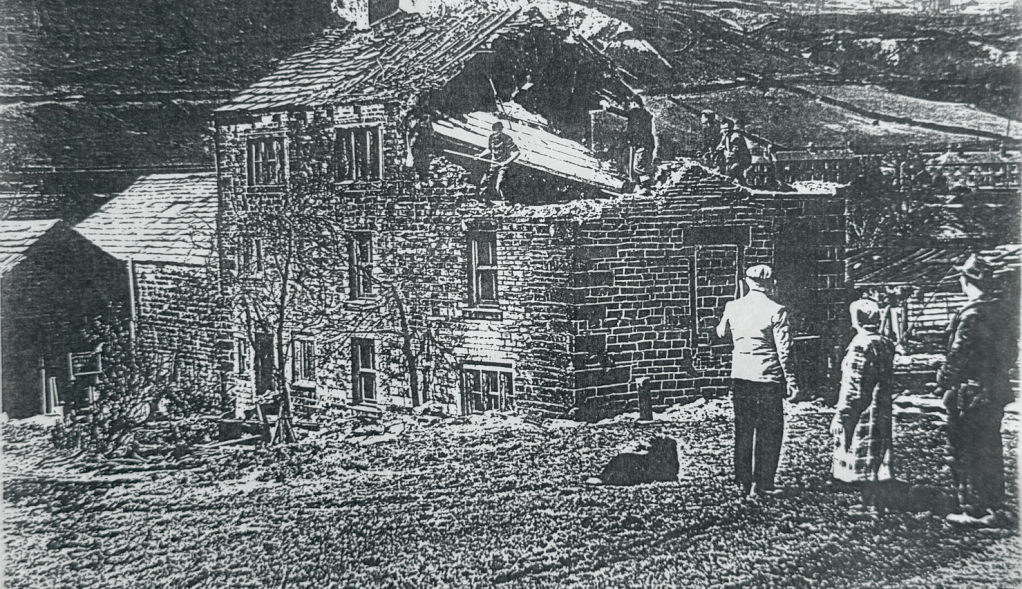
Time marches on. Through the farm in Carr Lane, Uppermill, where Mr Ernest Schofield, better known to his friends as Ernest o’Derby’s, was born and had lived his seventy-odd years, a new modern road is to be driven, and on either side of it will grow up a big Council housing estate.
It may be all done in the name of progress, but it is the sort of change Ernest doesn’t like. Since the local council bought the land and farm a year or two ago, the tenant was put on short notice to leave when necessary.
But this veteran huntsman and farmer, who loves dogs and horses and all wild creatures and is part of the quiet countryside, had hoped against hope that he might be able to stay in Carr Barn farm for the rest of his days.
He will of course, be compensated for having to give up the farm, where his father lived before him and the council will find him another house.
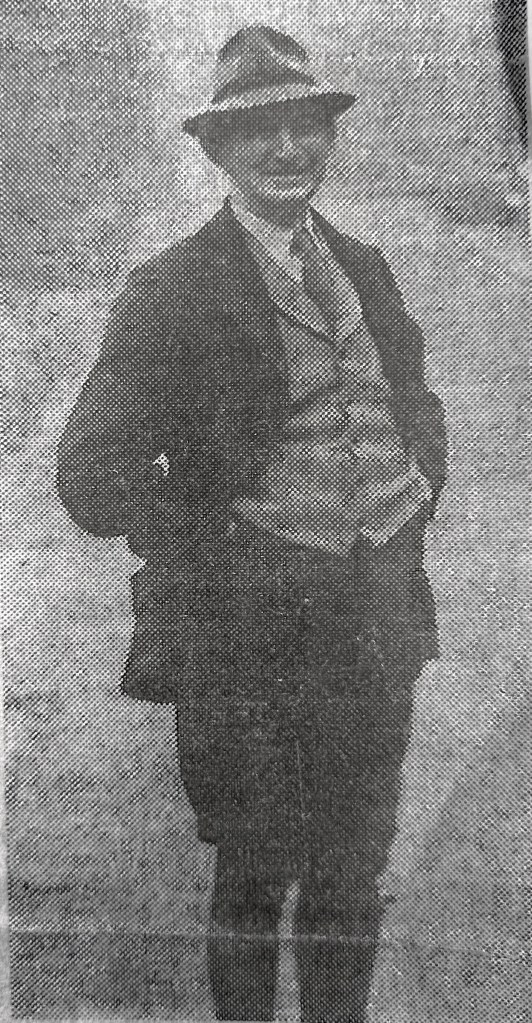
The Oldham Chronicle reported on the death of Ernest titled Man who never worked did plenty of living. With the death on Friday last week of Mr Ernest Schofield, of Carr Lane, Greenfield. Saddleworth has lost one of its most celebrated characters. The name, however, will be unfamiliar to most, for Mr Schofield was known throughout the district as Ernest o’Darby’s or to his intimates, as plain Darby.
Darby was an intriguing character but he had an underlying simplicity which spoke of country ways.
His philosophy of life was simple, He was always proud to tell you, “I never worked.” He always used to say that the best day’s work he ever did was when he found himself a wife at the age of 60.
Ernest o’Darby’s never did a regular day’s work in his life but few men crammed so much living into 83 years.
He went to Carr Barn Farm, Greenfield, as a baby when his father, Ben o’Darby’s, became tenant. The family had a local reputation in the Wade Lock area. His uncle sold cockles and mussels in Uppermill and his Aunt Mary went round the local public houses selling nuts and oranges.
If Ben expected any help on the farm from his son, he was disappointed. Ernest used to tell with a chuckle how he stayed in bed until he felt like getting up. “There was allus somebody else around to do a bit,” he would say.
But Darby was no slouch when it came to horses. he loved them and spent the best part of his youth walking to horse fairs in Yorkshire, Cheshire, Derbyshire and Wales.
Darby exhibited his beloved horses and rode them in meetings all over the north and, times being what they were, he gained a bit of a reputation too, as a wrestler, boxer, jumper and runner.
Ernest o’Darby’s was a self-confessed rake until his 27th birthday. Then his mother took him in hand, threatened to turn him out if he didn’t turn over a new leaf and put Darby off drink for the rest of his life.
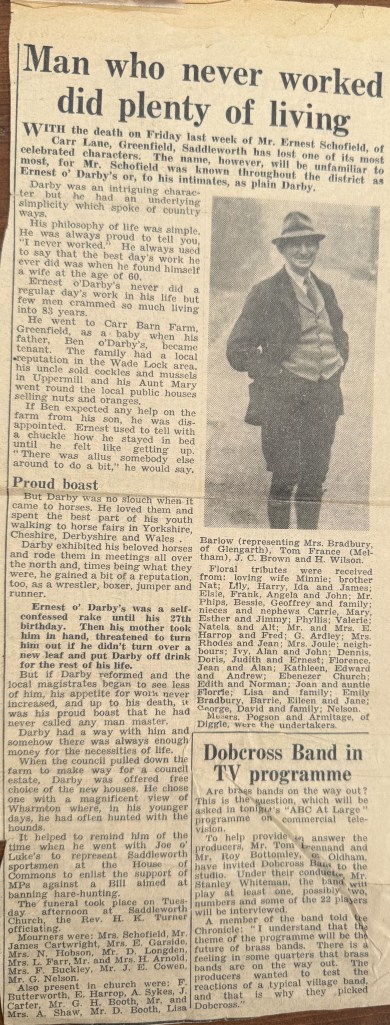
But if Darby reformed and the local magistrates began to see less of him, his appetite for work never increased, and up to his death, it was his proud boast that he had never called any man master.
Darby had a way with him and somehow there was always enough money for the necessities of life.
When the council pulled down the farm to make way for a council estate, Darby was offered free choice of the new houses. He chose one with a magnificent view of Wharmton where, in his younger days, he had often hunted with the hounds.
It helped to remind him of the time when he went with Joe o’Luke’s to represent Saddleworth sportsmen at the House of Commons to enlist the support of MPs against a Bill aimed at banning hare-hunting.
The funeral took place on Tuesday afternoon at Saddleworth Church, the Rev H K Turner officiating.
A scan of the parish registers indicate the burials of William Schofield (address Bill o’Darby’s) St Mary’s Gate 1905 and a Joseph Schofield (Darby) of High Street Uppermill 1903.
There is another plot, that contains Ben Etchells a farmer at Carr Barn Farm buried 1905. Also of Carr Barn Farm, a Ben Schofield buried 1919, Esther 1923, Abraham 1949 and Mary 1959.
Dennis Langdon worked at Carr Barn Farm and became the son Ernest never had learning much through his friendship with Ernest. He went on to become a Carriage Restorer, purchasing Husteads Farm in Dobcross in the 1950s. He went on to continue his passion for Horse Keeping. He also built Gypsy vans or ‘Vardo’ each taking six to seven years to build. Dennis has his ashes buried at the farm with his beloved Donkey. Judith his daughter, purchased a Vardo, (pictured below) in memory of her father. In 2021, Judith celebrated her 50 years anniversary as owner of the Husteads Riding School.


 Historic Saddleworth Church