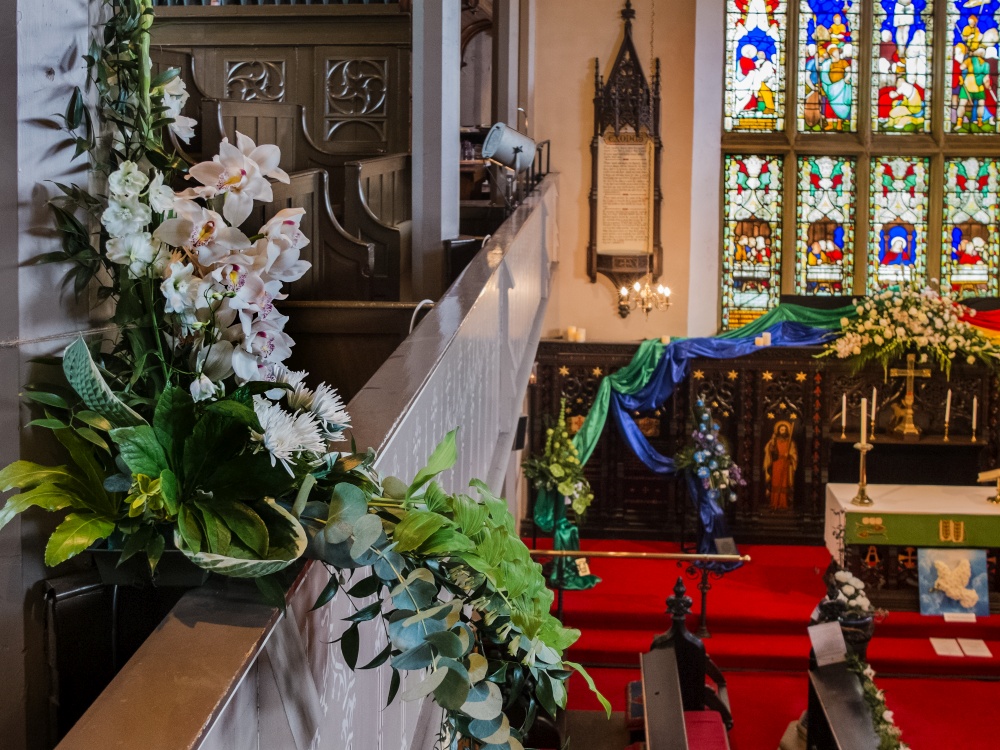
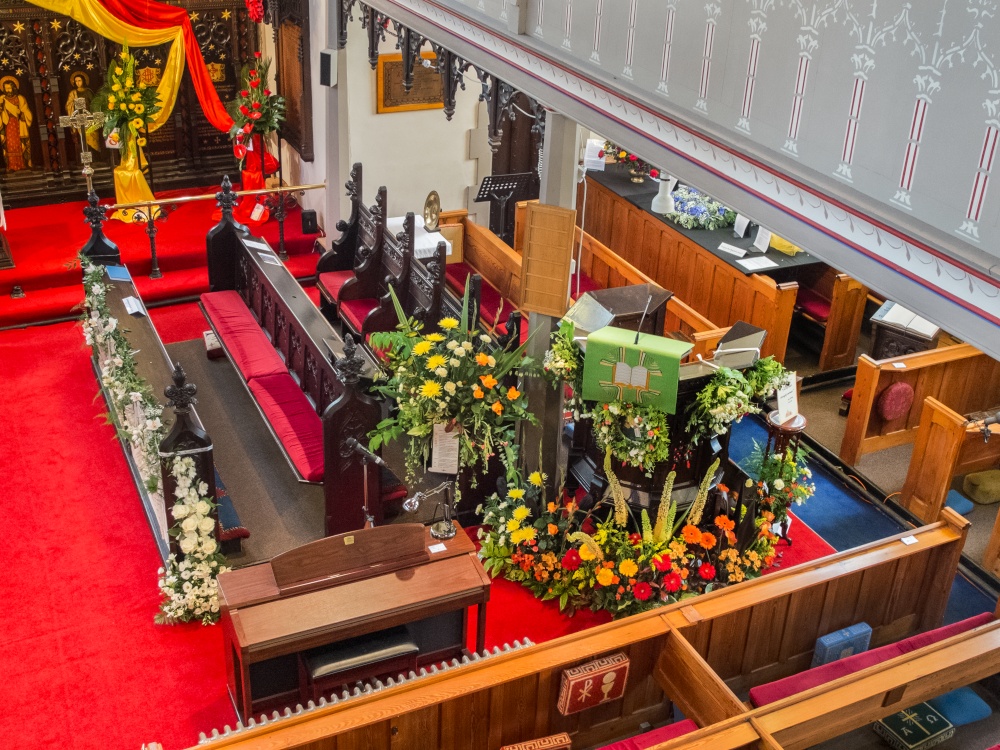
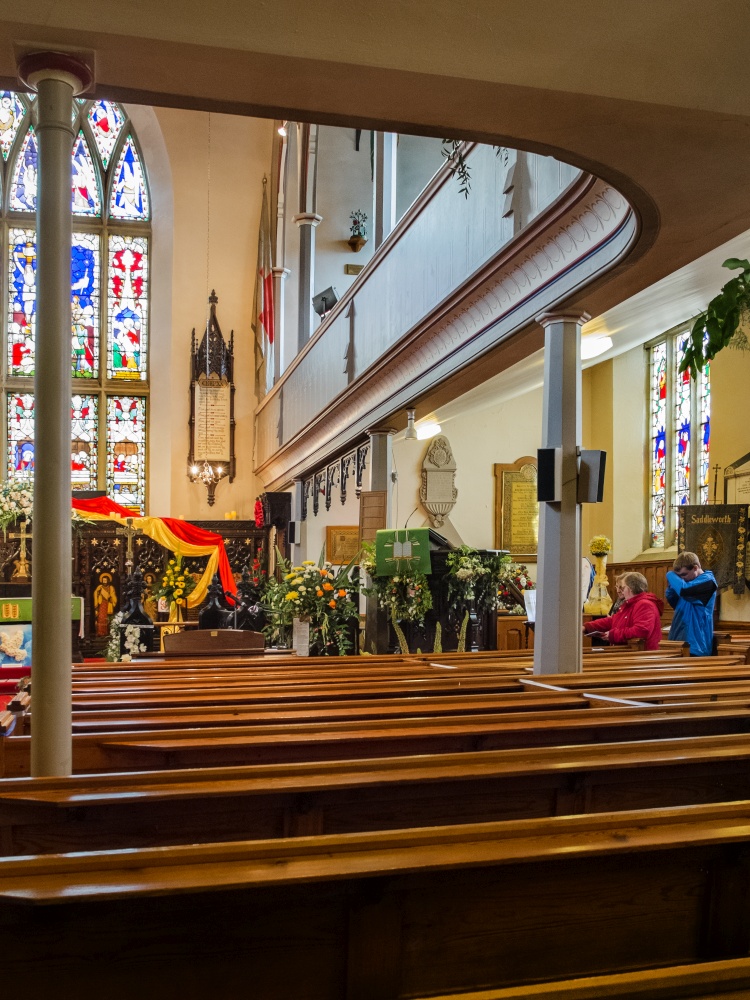
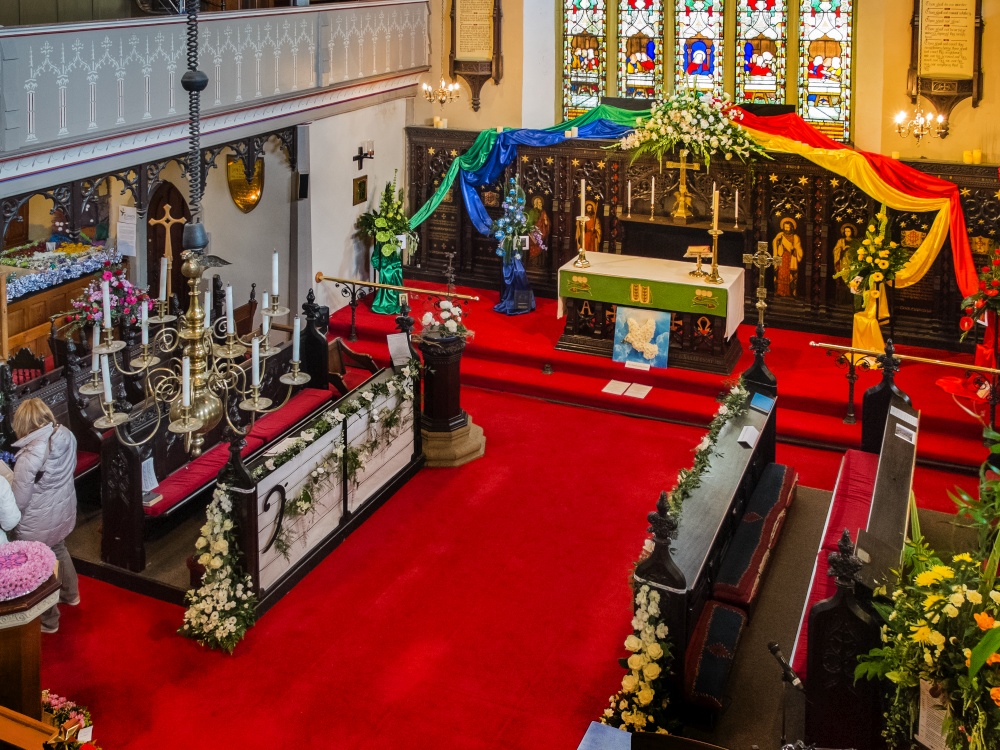
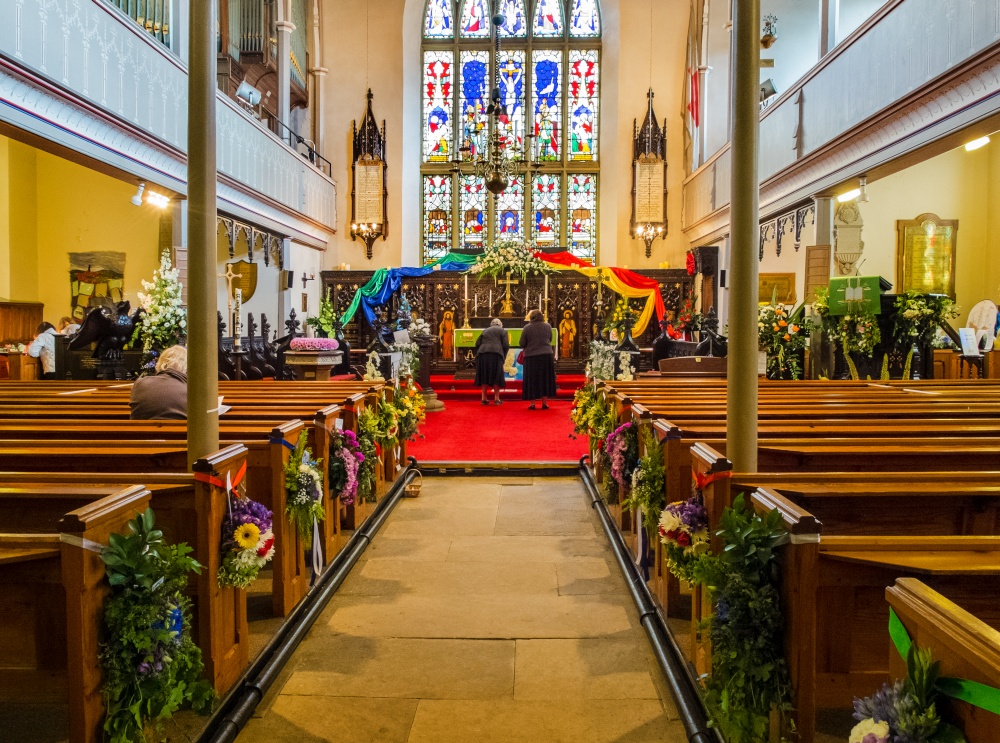
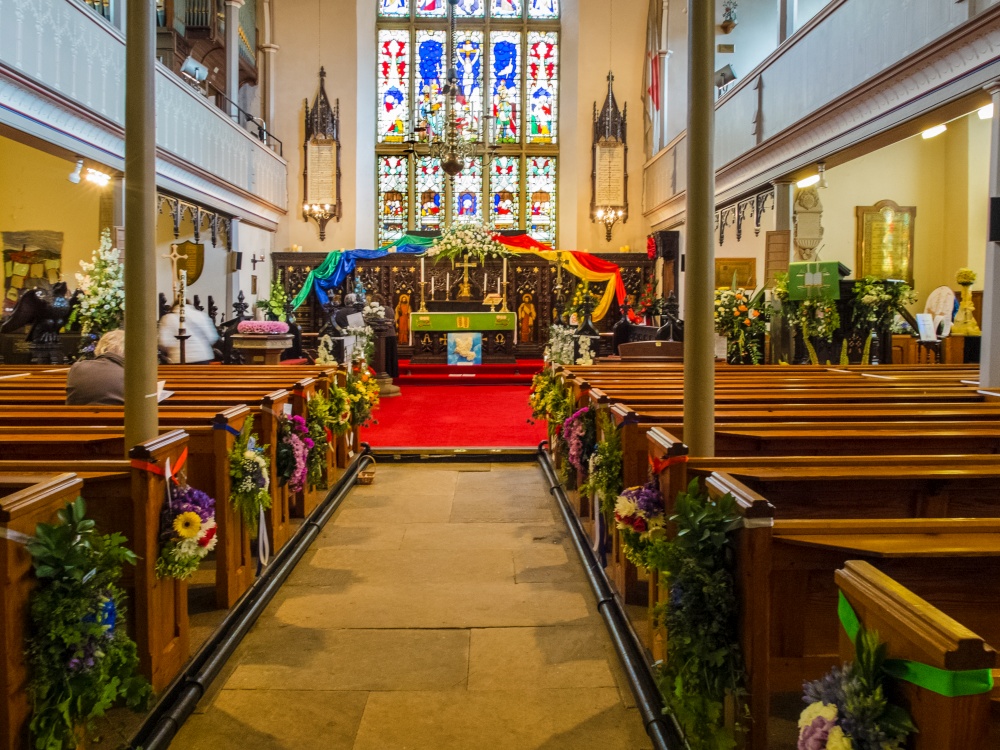
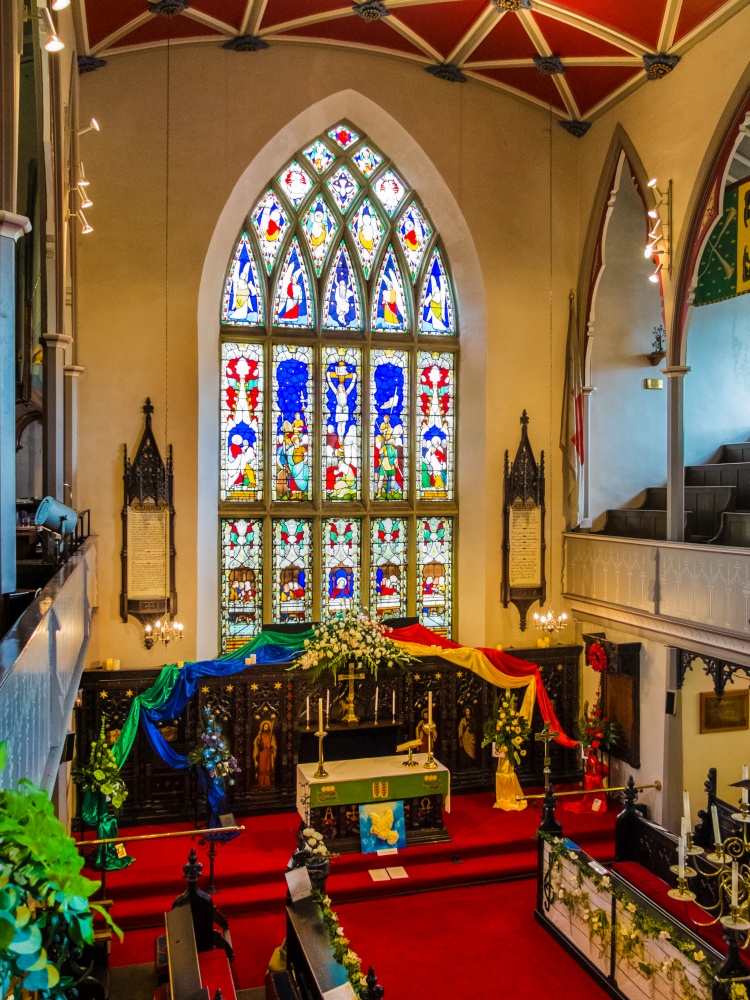
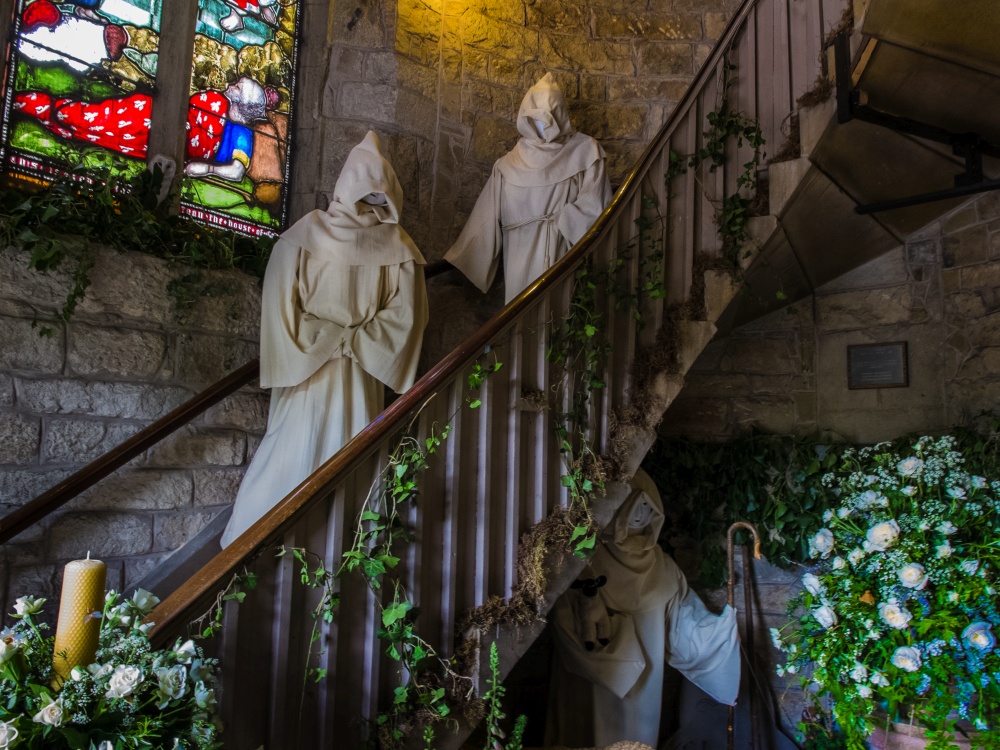
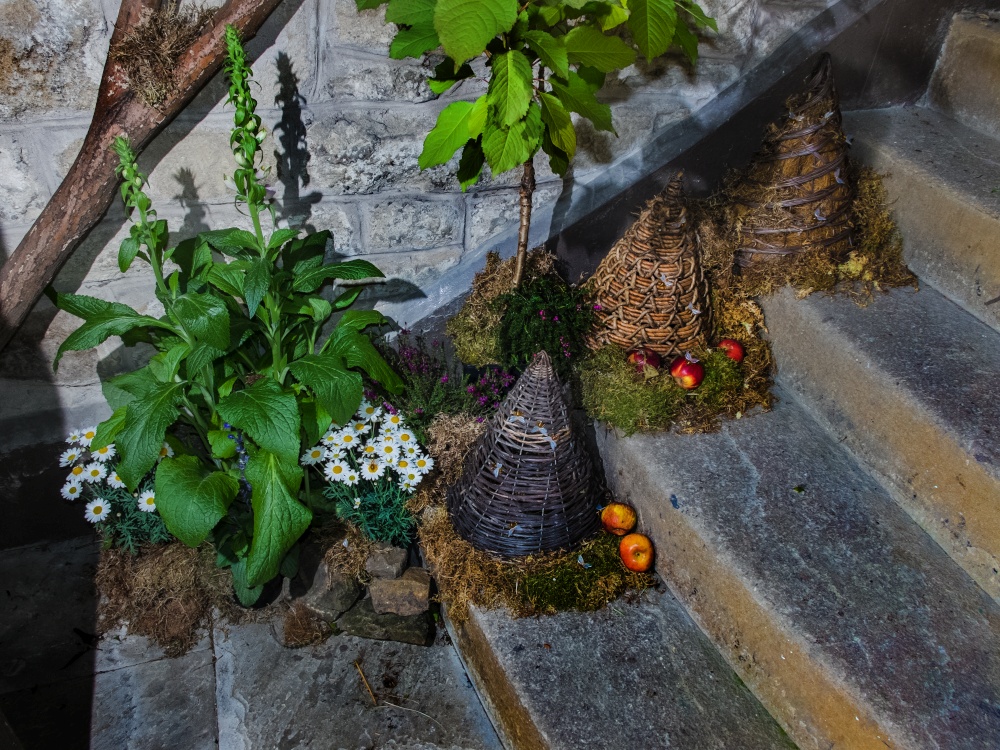
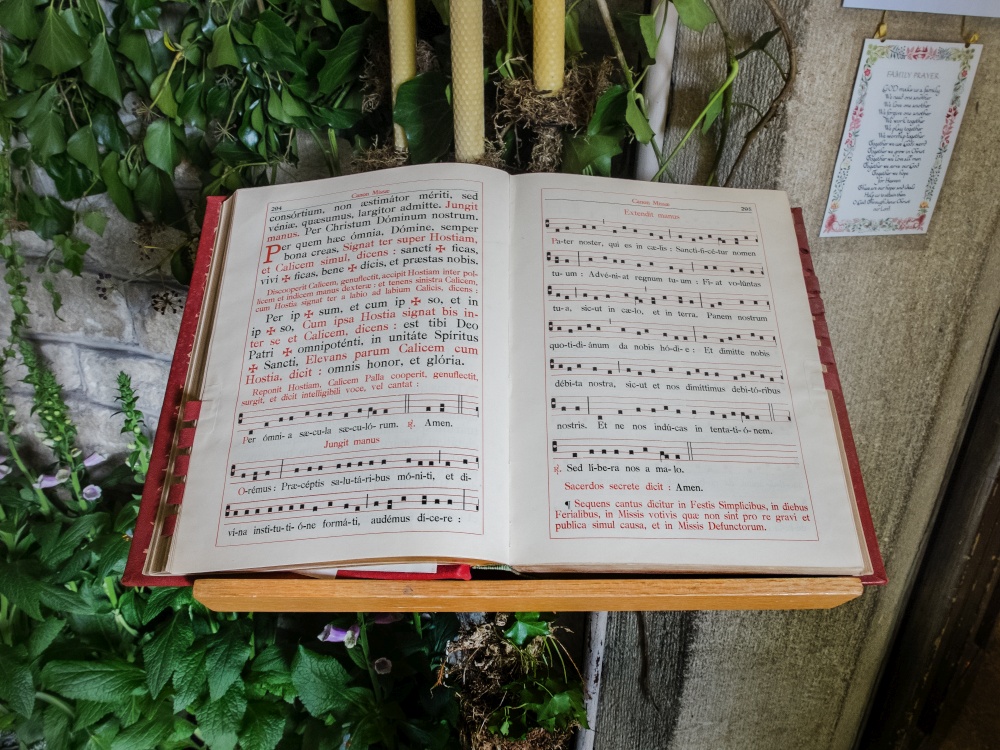
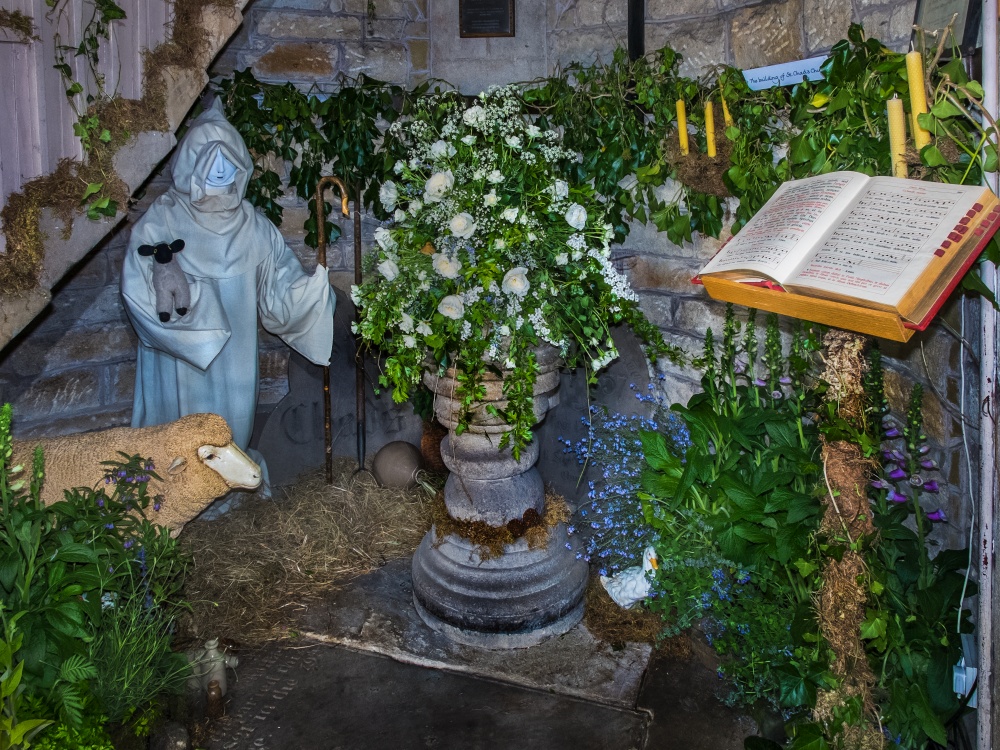
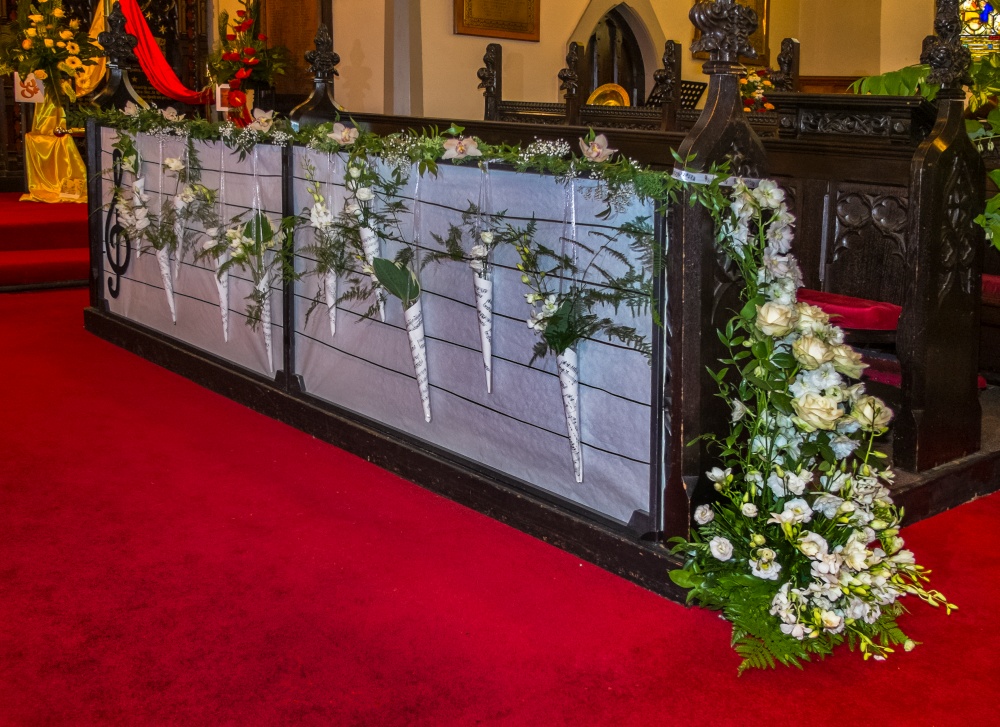
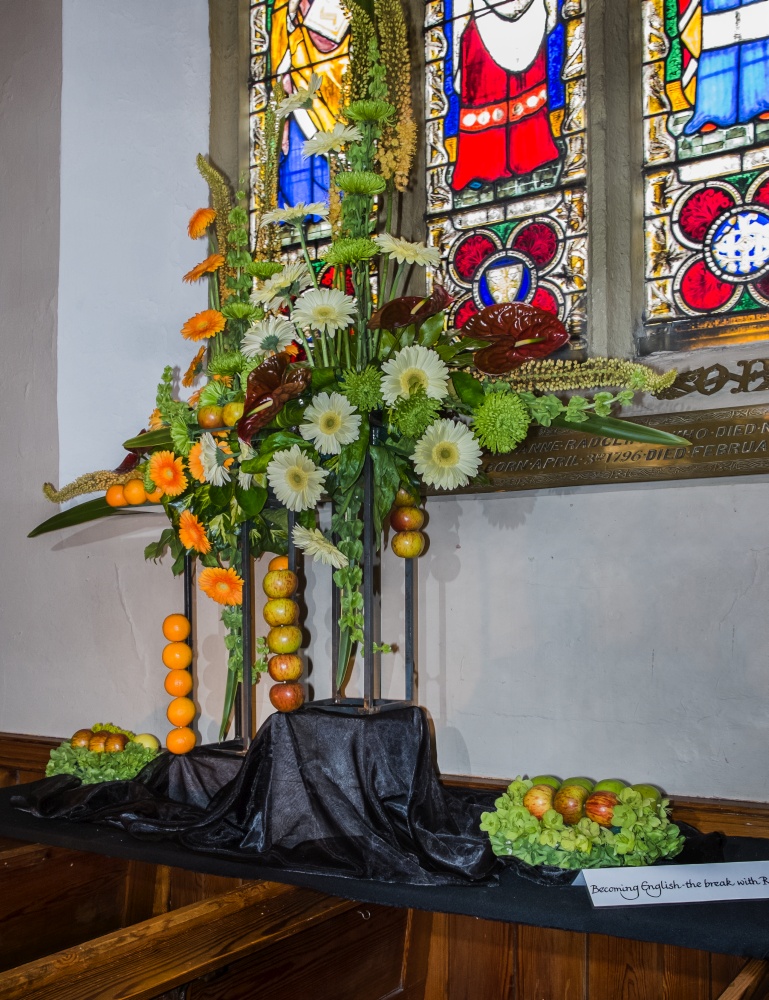
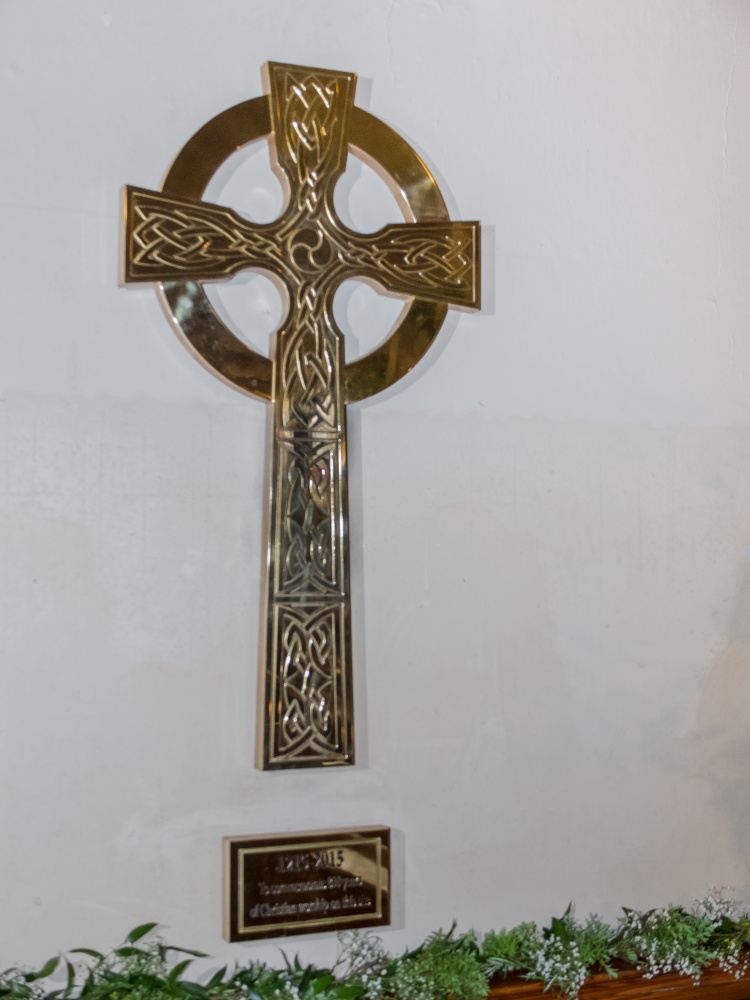
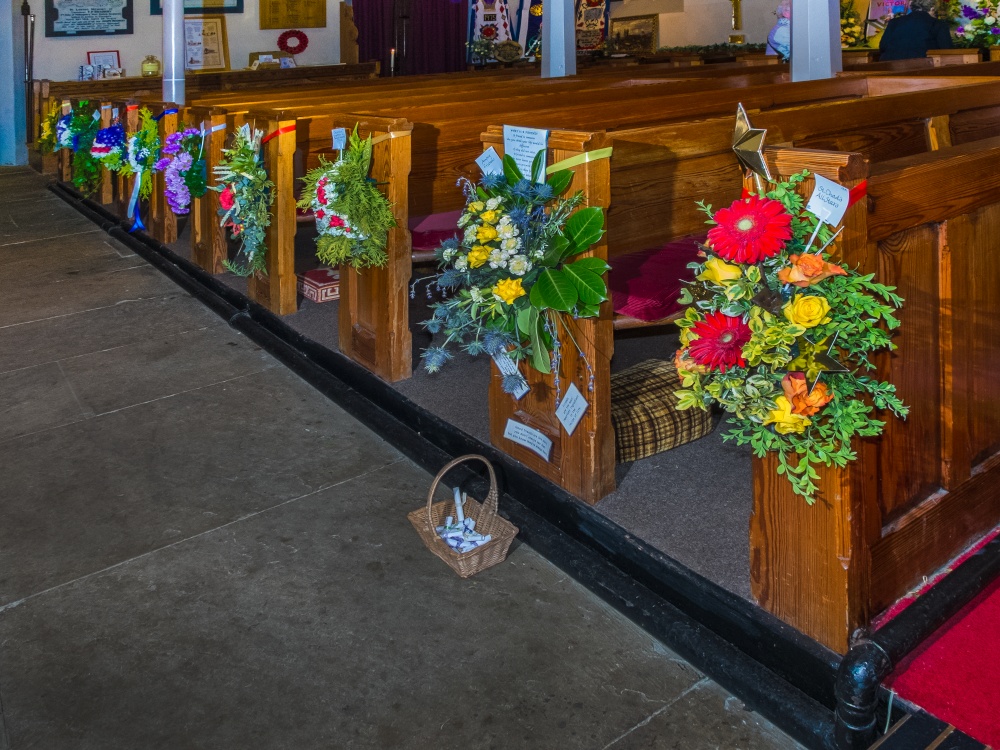
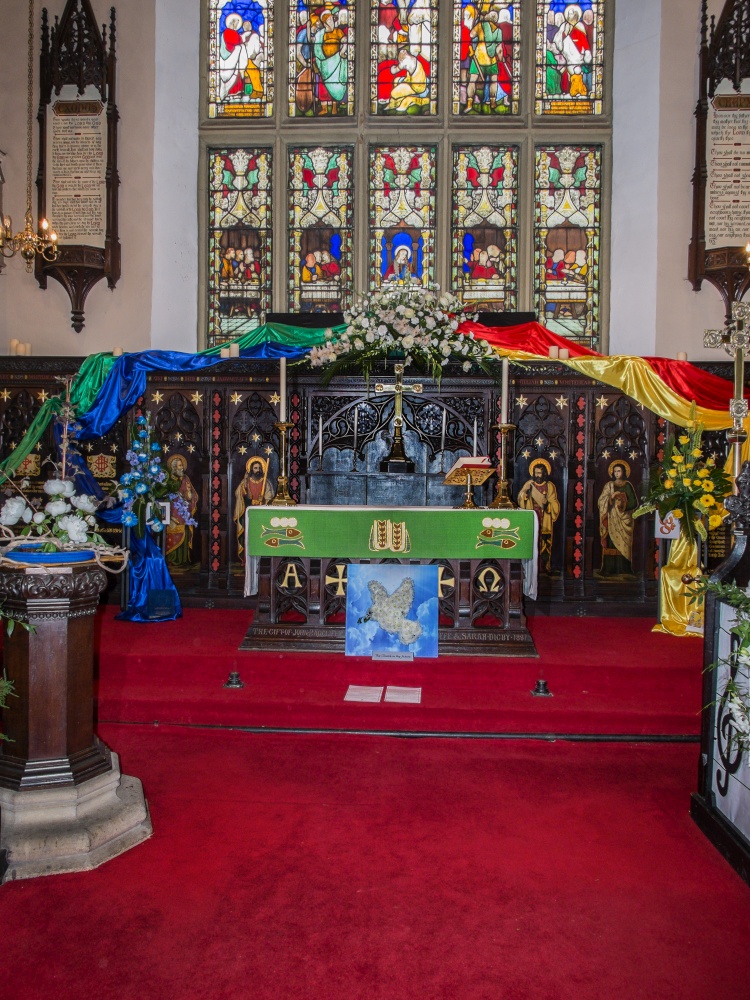
Celebrating 800 years of Saddleworth Church, a flower festival was held 5th – 9th June.
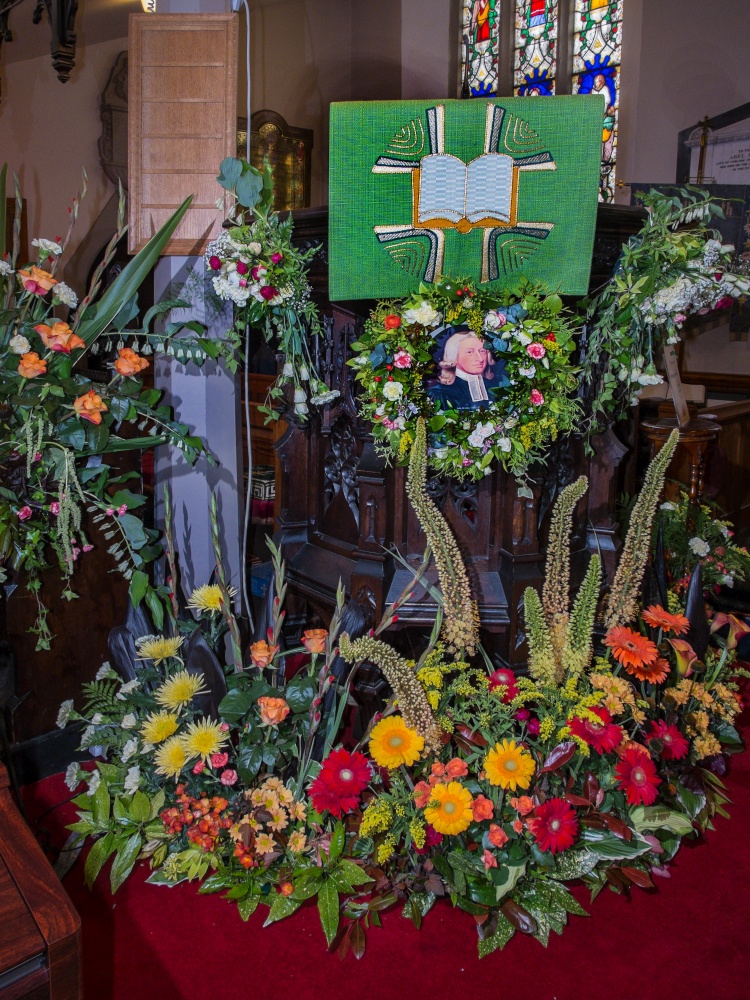
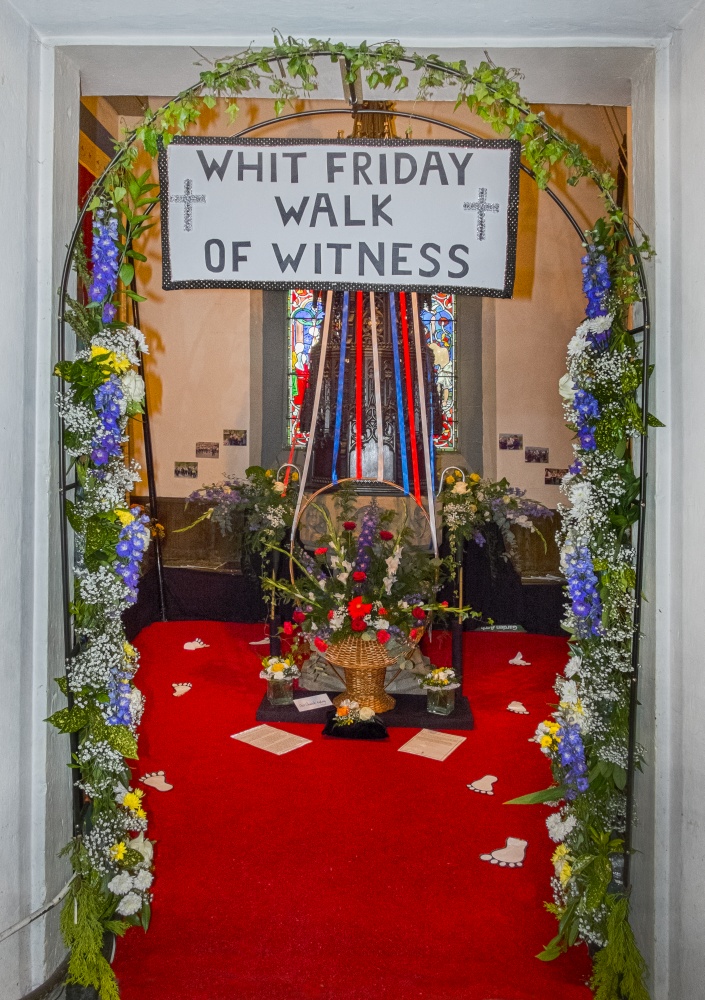
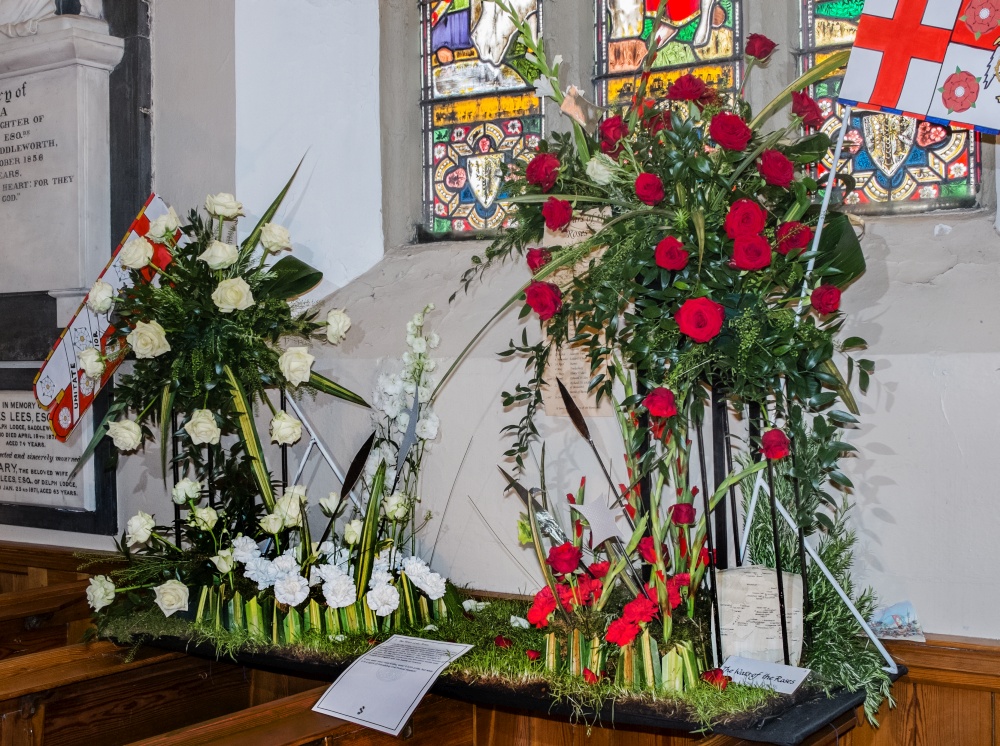
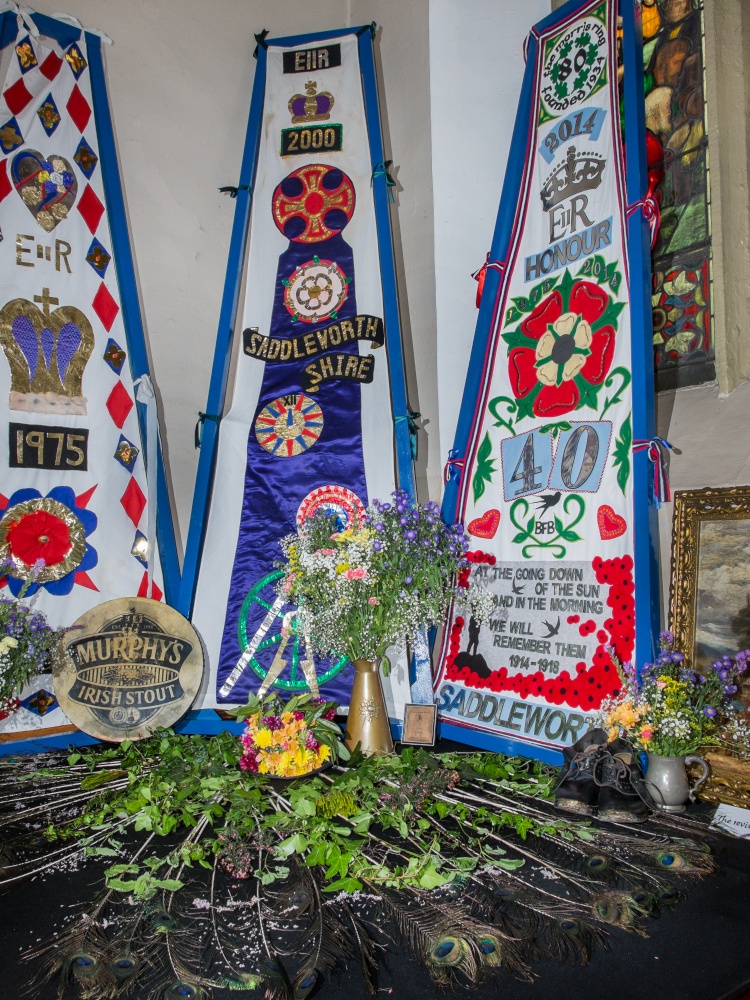
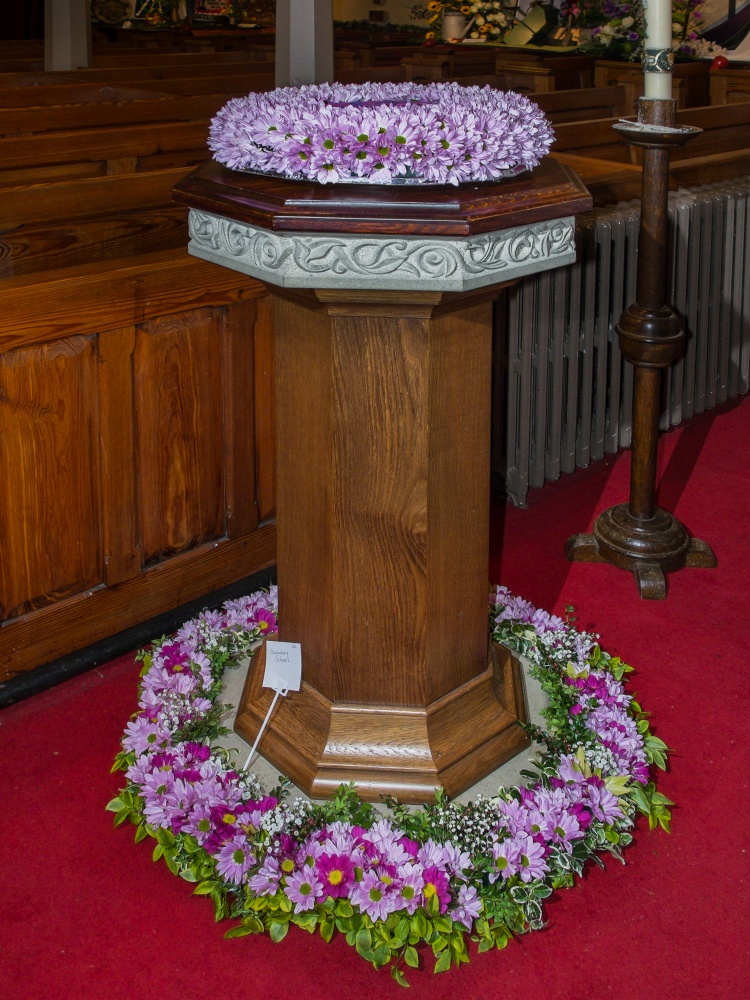
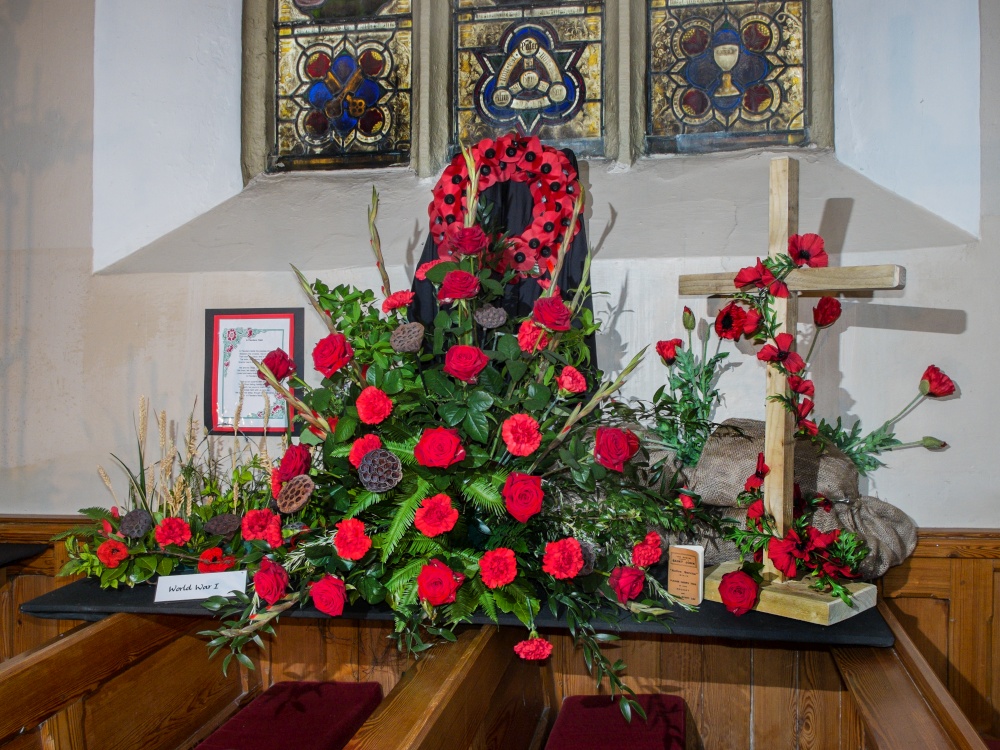
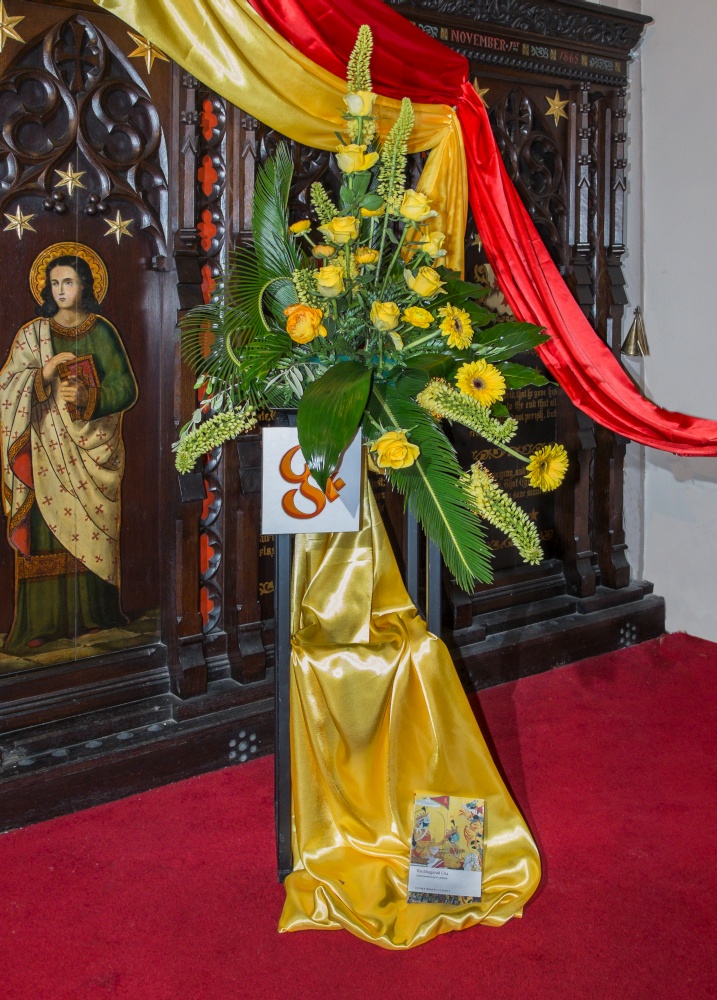
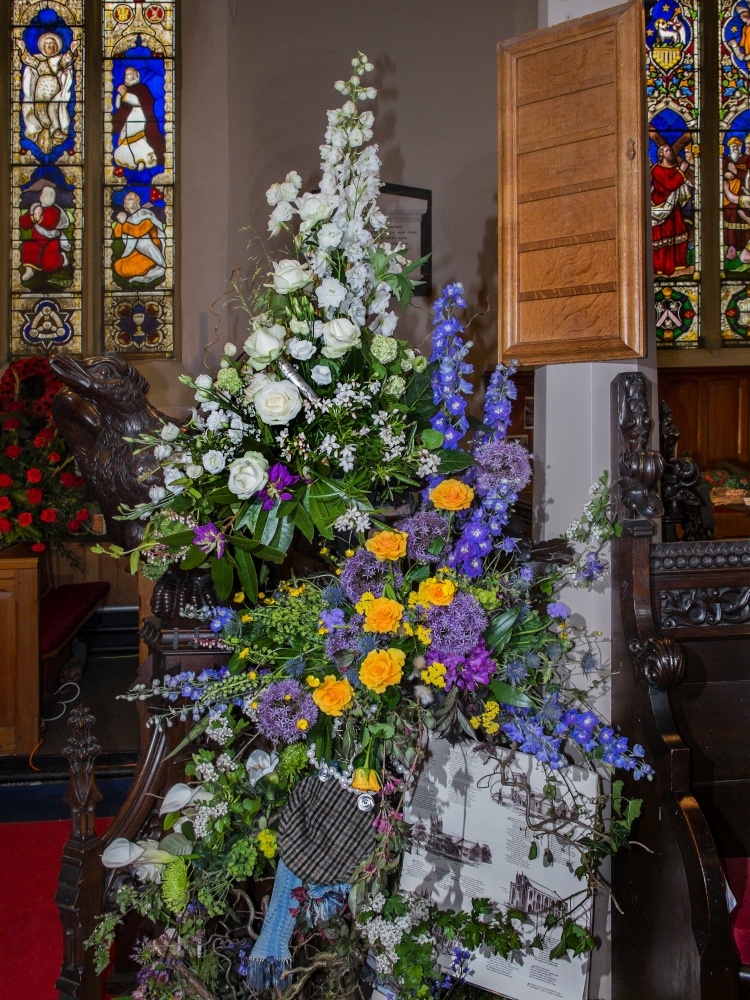
Providing visitors with a booklet, outlining the history of the church, read below and at the bottom of the story preview the flower display.
Thank you to Marit for providing her copy of the portfolio.
The building of St Chad’s Church
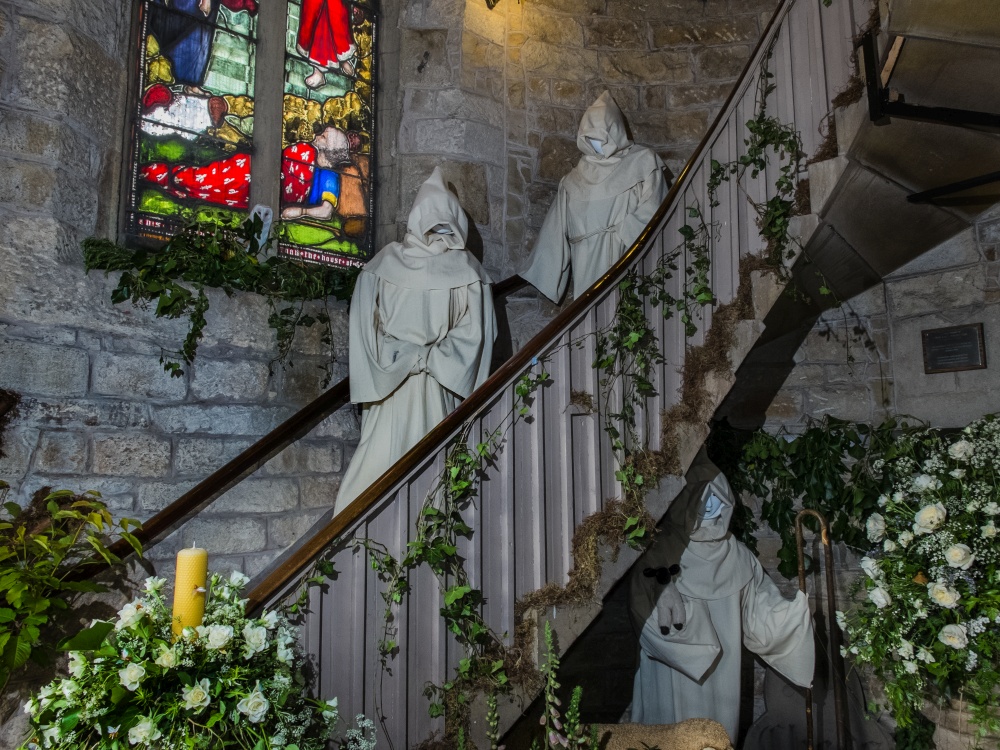
Around 1215 there began the building of a chapel in Saddleworth. Soon there was a link with the monks of Whalley Abbey, who gave support to the new Christian community. And, of course, it became part of the Catholic Church, directed from Rome. The good people of Saddleworth were linked to Europe, and the Mediterranean, where Christianity began and grew. The language of worship, and the Bible, was Latin.
The present-day descendant of this Roman Catholic Church, is the Sacred Heart and St William church on the High Street in Uppermill.
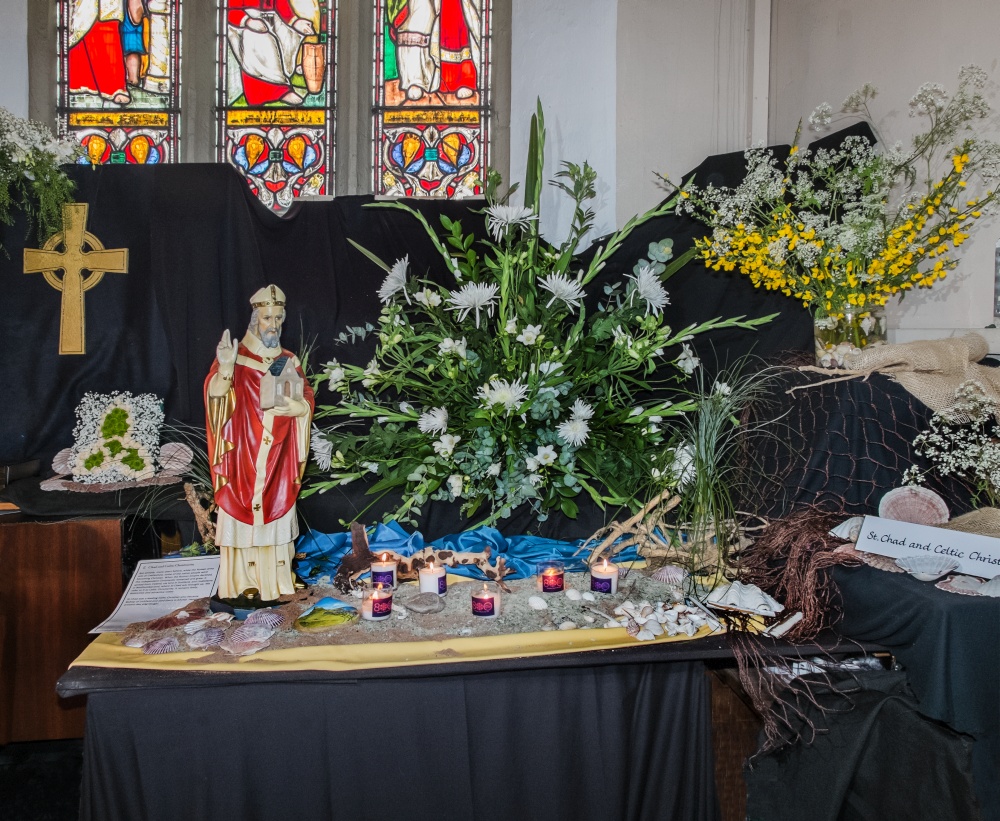
Chad and Celtic Christianity
But already, many years before, while the Roman army was at Castleshaw, some of the native people were becoming Christian. When the Roman Empire declined, this independent Christianity remained and grew. It spread from Ireland, via Iona in Scotland, and Lindisfarne in Northumberland, where St Chad was brought up. We refer to it as Celtic Christianity. It remains lively, distinctive and attractive today.
St Chad was a leading Celtic Christian who became Bishop of Lichfield and died there in 672AD. Hence the present-day pilgrimage!
The Wars of the Roses
Loyalty to the white rose of York rather than the red rose of Lancaster still matters to many of those born and bred in Saddleworth. In this twenty-first century, it might lead to argument, but not, we trust, to bloodshed! it’s a sobering thought that in March 1461 the struggle for power, for the throne of England, between the Houses of York and Lancaster, produced the bloodiest battle ever fought on English soil, the battle of Towton.
If you wear your rose today, wear it with pride, but wear it in a spirit of friendship and mutual respect!
Becoming English-the Break with Rome
It was Henry VIII who fell out with the Pope; but not until 1558, when his daughter Elizabeth was Queen, was the Act of Supremacy passed which made the Church of England a separate Church. At this point, the previously Catholic Church of St Chad became an Anglican Church. Thanks to advances in printing, this period also saw William Tyndale’s translation of the Bible (1526), the Authorised version of the Bible (1611) and the 1662 version of the Book of Common Prayer.
The English people could begin to read about God for themselves!
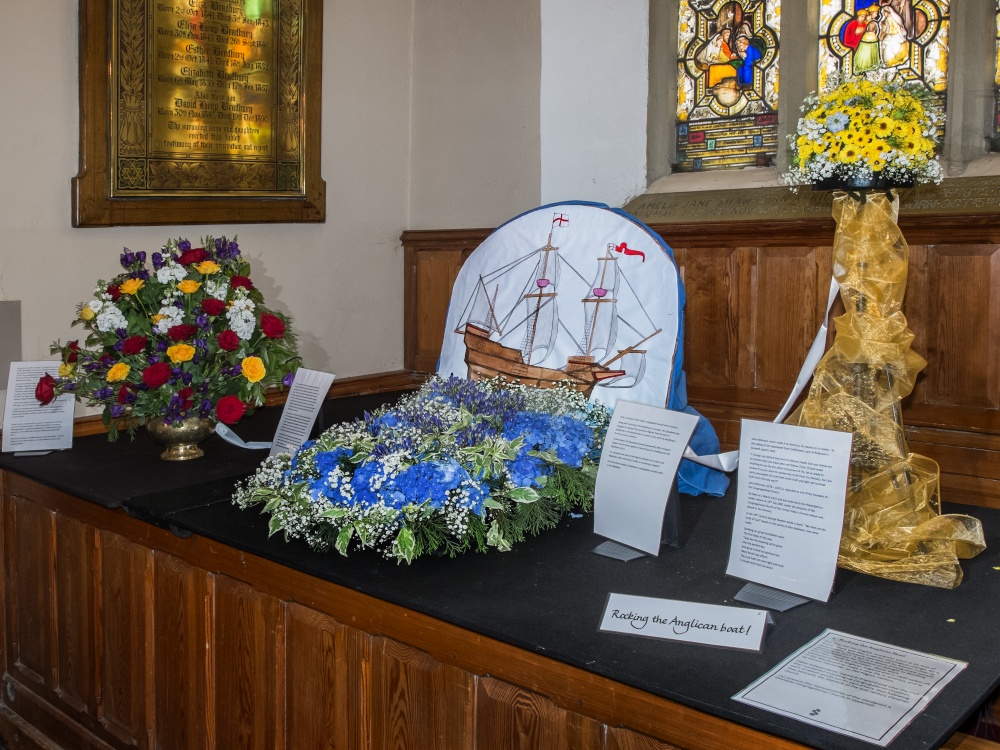
Rocking the Anglican Boat
Not only did the English monarchy want to be free of Rome, there was also a call for theological change, for a Reformation, famously sparked off by Martin Luther in Germany in 1517. It led to a desire amongst some people for independence for freedom of though in deciding how they should be Christian. Some were uncomfortable in Anglican England and in 1620 sailed off in the Mayflower to make a new life in America, and to be known thereafter as the Pilgrim Fathers.
Other independents stayed in England and after the Civil War succeeded in setting up Congregational churches, each of which would run its own affairs, thus following, they believed, the example of the first century Christian church.
Our present-day representative of this standpoint is Ebenezer Congregation Church in Uppermill
The Growth of Methodism
John Wesley, travelling North from Stockport on horseback, and seeking to breathe new life into local Christianity, made his first journey into Saddleworth in 1760. Apparently, he almost lost his way, but eventually found Greenfield-where, on some future occasions, he may have sat on the legendary chair! He then made his way via Kinders Lane past the now long-established Saddleworth Church and so deeper into Yorkshire. In 1780, he returned to visit Delph, where Methodism had been making an impact since 1770, and a chapel was opened the following year, the first in Saddleworth.
From those beginnings Methodism grew and flourished and continues to have a strong presence with Methodist Churches in Delph, Greenfield and Uppermill.
The Growth of Saddleworth
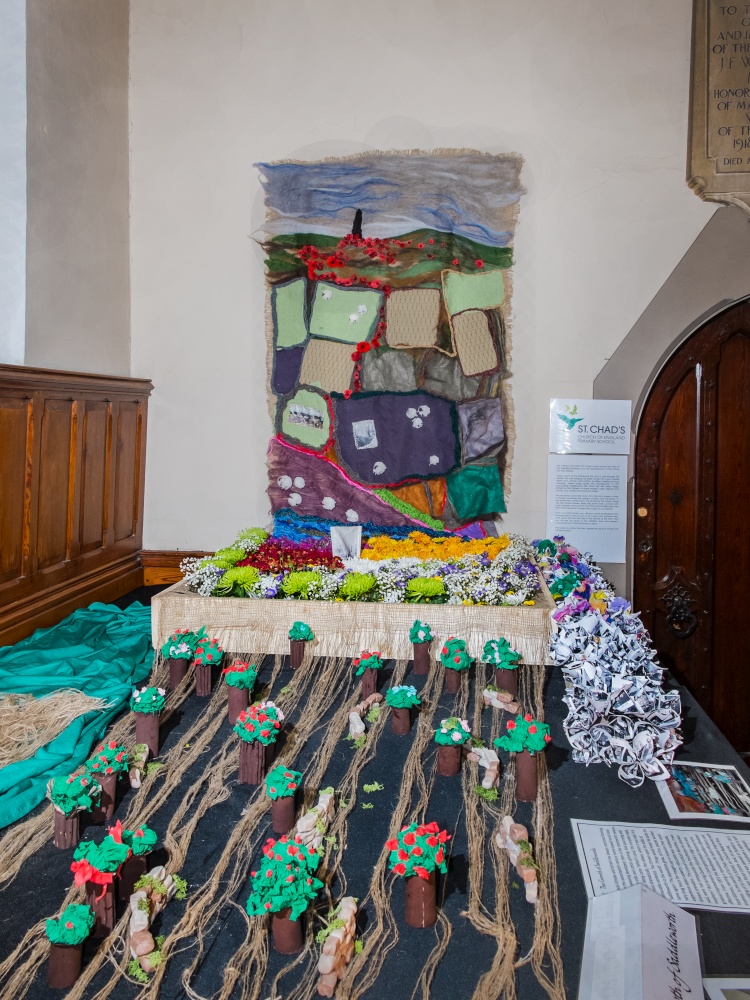
The local climate and terrain has always restricted farming, so from the seventeenth century home-based hand-loom woollen weaving developed: then in the nineteenth century there came mills and cotton spinning, quarrying, and reservoirs. Along cam Telford’s canal, the turnpike roads, and, most dramatically, the railway, which it was said, in a memorable sentence, has thrown open the wilds of Saddleworth to the world. Things would never be quite the same again! The population grew. At first, people worked very long hours for meagre pay-in recession they could experience adject poverty: education was inadequate, disease prevalent. The annual Rush Cart festivities, it was said, were not infrequently the touchstone for drunken mayhem! but during Queen Victoria’s reign there was gradual improvement. Local government became more effective. From 1853 the workhouse Guardians alleviated local distress, earning a reputation for both efficiency and kindness. In the parish of St Chad, education improved with the building of St Chad’s School, on Church Road at first, then at the Parish Centre. Followed by Saddleworth Council School which opened at Pickhill in 1911. The cooperative movement helped inculcate a spirit of self-help, and, let it be said, the churches made a significant contribution to local well-being.
Ammon Wrigley
like the wind among the heather
Just as careless and as free
Up and down this old moor parish
Let’s go tramping, you and me …
If we meet some hungry beggar
Shall we pray that he be fed?
It were better and more Christian
That we give him cheese and bread!
Born in 1861 at Far Hey on the bleak uplands of Friarmere, Ammon Wrigley – poet, writer, historian and archaeologist- spent all his 85 years in Saddleworth and is still, quite rightly, very much remembered with affection. He had no time for religion that bore no fruit in action. One of his favourite dialect words was Jannock meaning pleasantly outspoken, straightforward, honest, generous
Jannock, is what he sought to be, and encouraged all of us to be
Two World Wars and Women’s rights
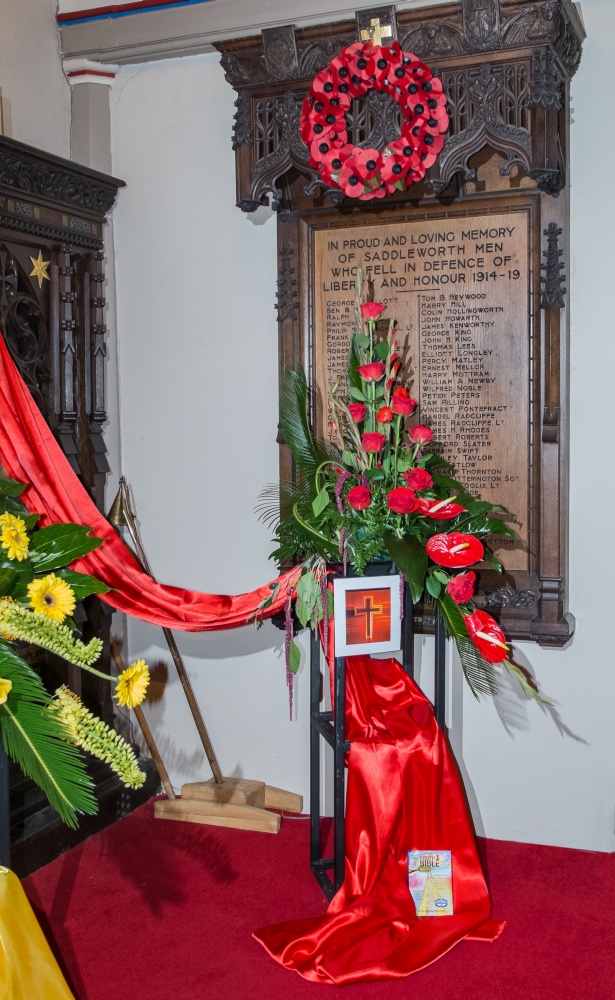
Excited, patriotic crowds cheered men recruited to fight for King and country in the First World War. At its end, when a memorial to those who had died was unveiled, the local newspaper announced that the ex-servicemen of Saddleworth received a right royal welcome home on Saturday whilst acknowledging the sadness of the occasion: a touching tribute of respect was paid to the two hundred Saddleworth men who have laid down their lives in the country’s cause
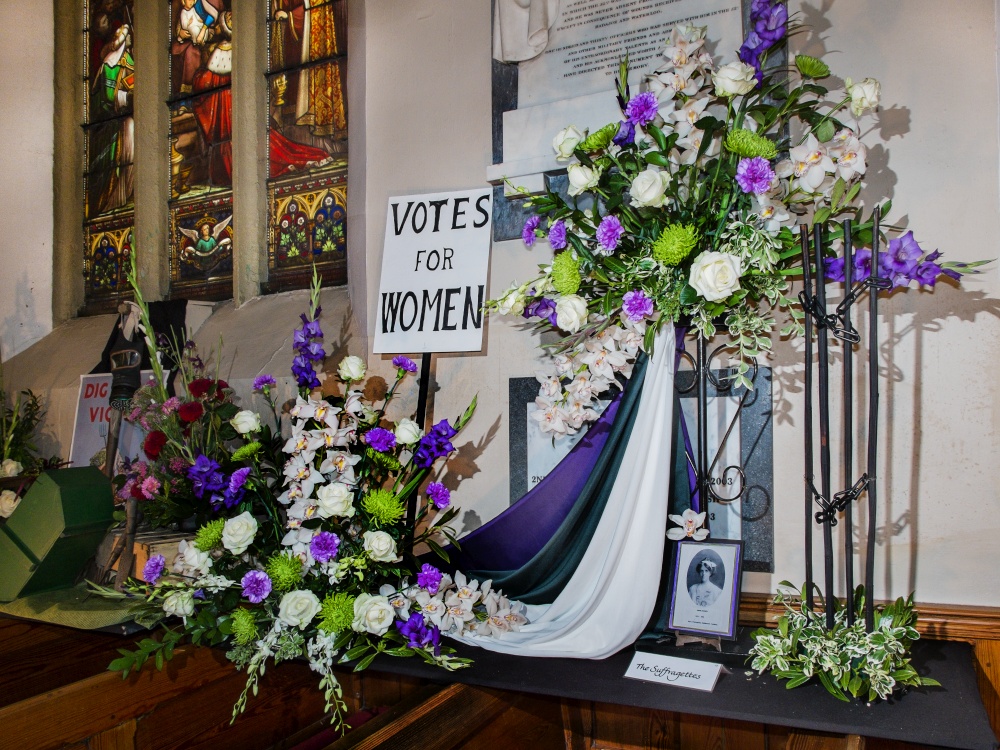
That not only men but women should play their part in the war effort was the opinion of Annie Kenney from Springhead. She also believed that women should have the same rights and status in society as men. She was an active suffragette and rejoiced when women won the vote in 1918. As we might rejoice in 2015 that the Anglican Church at last has female bishops.
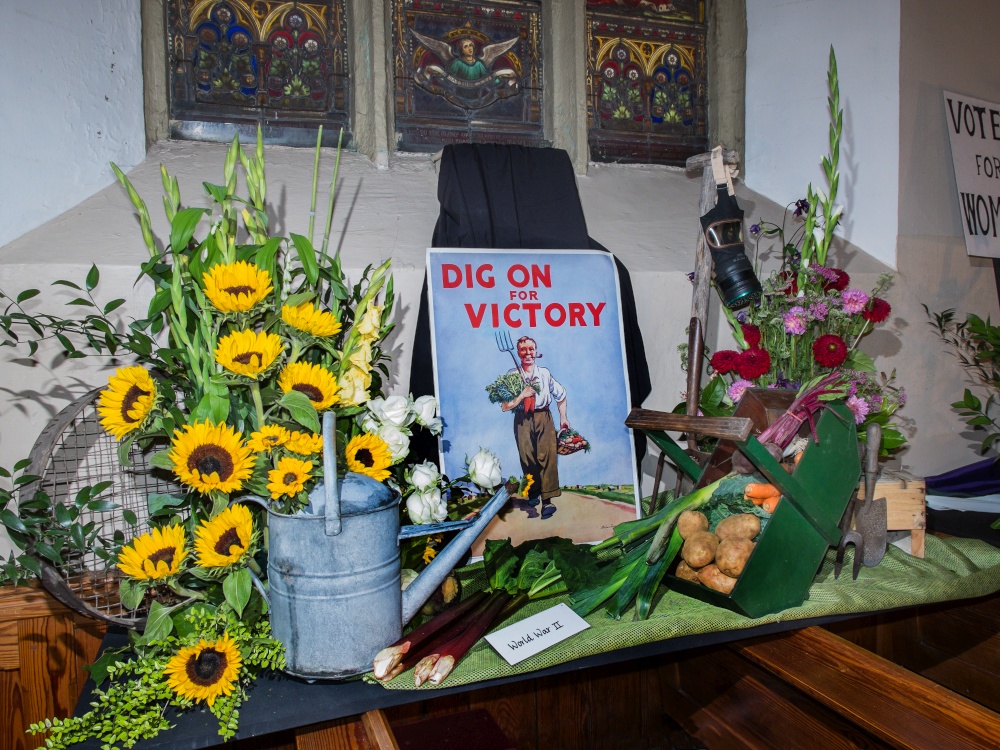
During the Second World War, Saddleworth was fortunate to be on the edge of the Manchester conurbation, though the local mills were viewed as possible bomb targets by the Germans. A bomb did land unexploded on the Greenfield Cricket ground, but Saddleworth, fortunately, escaped bomb damage.
Blackouts, however, were part of local life for five years. Men of military age, of course, were conscripted. Older men with previous military experience joined the Home Guard. The younger women were nearly all employed in providing vital support to the war effort. Sadly, the war once again took a serious toll of local lives.
Revival of the Morris Men and the Rush Cart Festival
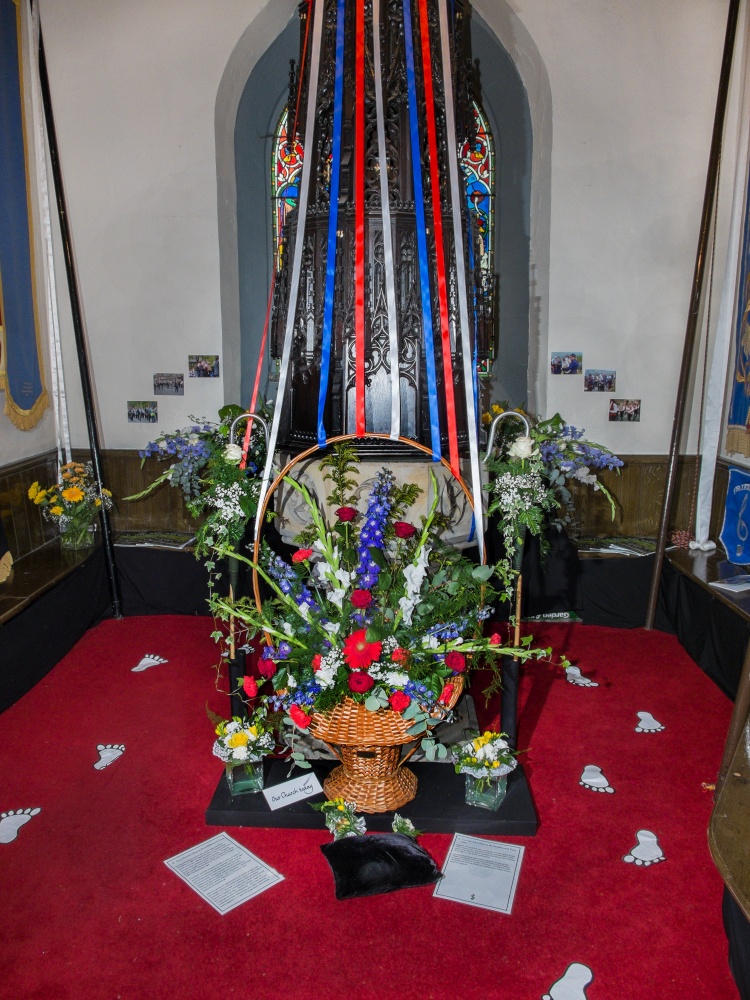
In the 1970s there was a general revival of folk traditions. Peter Answorth took the lead in setting up a Morris Team and was offered accommodation in the Barn by the landlord of the Cross Keys. Some f the old steps were remembered and new dances were created. So began the dancing revival. Then came the thought of reviving the Rush Cart Festival which had traditionally taken place at Saddleworth Wakes, but had died out at the end of the nineteenth century. Lord Rhodes was supportive in persuading the reluctant Vicar to revive a long-abandoned ancient custom and have rushes laid on the church floor! Fortunatey, there were still people around who knew how to build a Rush Cart.
Since 1974 the festival has taken place every year without fail, accompanied by the local Morris team and other dancers from further afield who have been invited to take part, and, a great occasion it is!
Our church today-in the Saddleworth Team
Having previously been in the rather large parish of Rochdale, in 1866 St Chad’s became an independent parish of its own. Within the parish of St Chad itself, there are three different places of worship – Kilngreen Church in Diggle, The Parish Centre in Uppermill, and St Chad’s itself-still situated on the spot where it began eight hundred years ago.
The three worship centres provide a variety of styles of worship, so endeavouring to meet the needs of all ages and temperaments. Both Kilngreen and the Parish Centre provide Sunday Schools and St Chad’s children are given special attention in the Baptistry. There are also occasional-very successful-workshops at the Parish Centre. Everyone is, of course, very welcome to everything!
After its period of independence, St Chad’s is again part of a larger entity, the Saddleworth Team [Benefice] of local Anglican churches. It is also part of a second wide grouping-Churches Together in Saddleworth, which embraces all the Christian churches-Roman Catholic, Anglican, Congregationalist and Methodist-who may once have emphasised their differences but today endeavour to work together in a spirit of cooperation and mutual support. Among the joint enterprises is the Good Friday silent procession of witness and the annual Whit Walks which precede the Band Contest and attract the interest of all ages in the local community.
The churches have aso come together to set up the Diggle and Uppermill Ecumenical Youth Project which employs a ful-time worker, who has a strong link with Saddleworth School students, particularly those in most need of support.
Our Church Today-the Various Groups
The Anglican Church in the parish of St Chad today seeks as it should, to be accessible to, and to meet the needs of local people. Kilngreen Church advertises itself as a great village amenity, a real community centre. It accommodates Beavers, Rainbows, Cubs and Brownies: parents bring toddlers to the play group, there are Painting and Yoga classes, and Kilngreen is the home of the locally famous St Chad’s All Stars and the irresistible Diggle Blues Festival. It welcomes birthday and family parties and is even licensed to perform weddings. The Kilngreen Supporters Club works hard to server the community.
The Parish Centre on Lee Street is also a well-used and much valued facility. To read the noticeboard there is to become aware of Yoga classes and Tai Chi; of Pilates, the Theatre School and Dance classes. The former school building is now home of Saddleworth Male Voice Choir. Here the Among Friends group for older people, initiated by stalwarts of St Chad’s Church, meets fortnightly and the Seeds group, similarly set up, but for very young children and their parents, gathers weekly. At monthly coffee mornings money is raised for a range of deserving causes. Upstairs is a room available for spiritual reflection and guidance and next to it is the Saddleworth Team Office.
There must also be mentioned the links the parish of St Chad has further afield. Local church attenders are among the advocates of a project which maintains personal contact with, and provides support for, people in the village of El Tular in El Savador. Others, likewise, take responsibility for the OATIN project which supports and maintains contact with AIDS sufferers inNambia and links with their Parish of the Holy Spirit, Oshandi. And, St Chad’s Church itself: which is cared for by its present congregation and by the fundraising efforts of the Friends of Saddleworth Church. As the poet Phillip Larkin put it a serious house on serious earth it is. To visit it, to look around it, to enter it, is to be reminded of the long story of Christian presence in this place; to be reminded of birth and baptism, of maturity and marriage, of mortality and the funeral service. It is to find ourselves, perhaps, considering for a moment who we are and who we are meant to be. In this most profound of ways our needs as a human being might be met.

 Historic Saddleworth Church
Fiona,
In the post, 2nd paragraph, the year should be 1215 not 2015.
Jeff
Sent from my iPad
LikeLiked by 1 person
Thank you
LikeLike