
Phillip Stevens, Vicar of Saddleworth, wrote the preface to a small booklet authored by Michael and Peter Fox, in May 1990.
They begin their story with a memory written by Ammon Wrigley.
I heard the bands playing merrily through the village streets. I saw little girls in white running down the steep hill fields to the school.
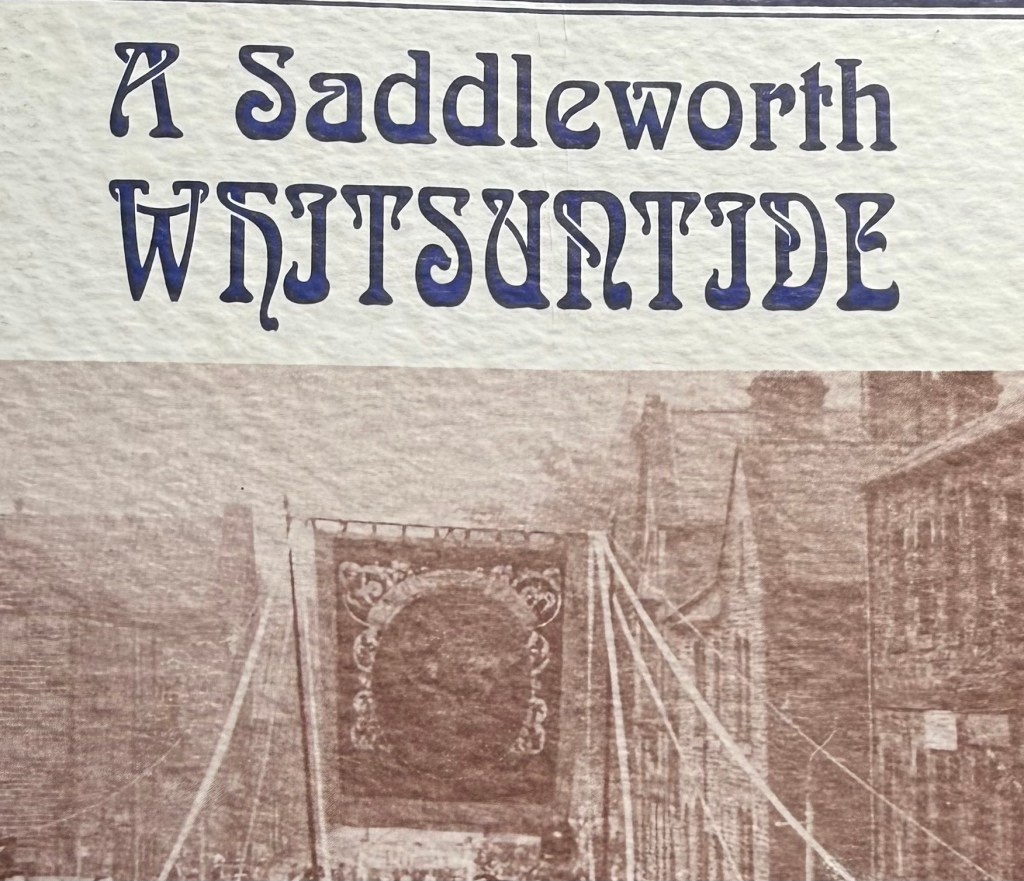
I thought I heard fiddle-playing and women singing on the top of Knott Hill, then I saw the long procession of scholars winding through the fields and the great silken banner of the church of St Thomas swaying in the wind.The roadway and the space in front of the hill are thronged with folks from the hillside houses, women folk talking and laughing in groups as light hearted as children…
The procession is nearing the church gates. The vicar, wardens and sidemen walk beneath the great banner-how stately and dignified they are. The church bell is ringing merrily, the talk ceases in the lane, and all eyes are eagerly scanning the procession to find little ones and to see if they have kept their new clothes nice and clean.
… I lean with my mates against the wall and old Esther o’th’ sheepcotes comes up and says: ‘it would never be wissun if aw didn’t see th’ children walk”…
Celebrated in the north of England but perhaps with greater zest in Saddleworth, Whit Friday as it has come to be known is an opportunity for the coming together of a scattered community. Religious services, processions and the enjoyments of music, sports and outings. A deep rooted tradition for many generations of Saddleworth people.
About 1850, the many separate holidays and processions were focused to the Friday before Trinity Sunday. Hence the name Whit Friday. A quote from 1871 describes.
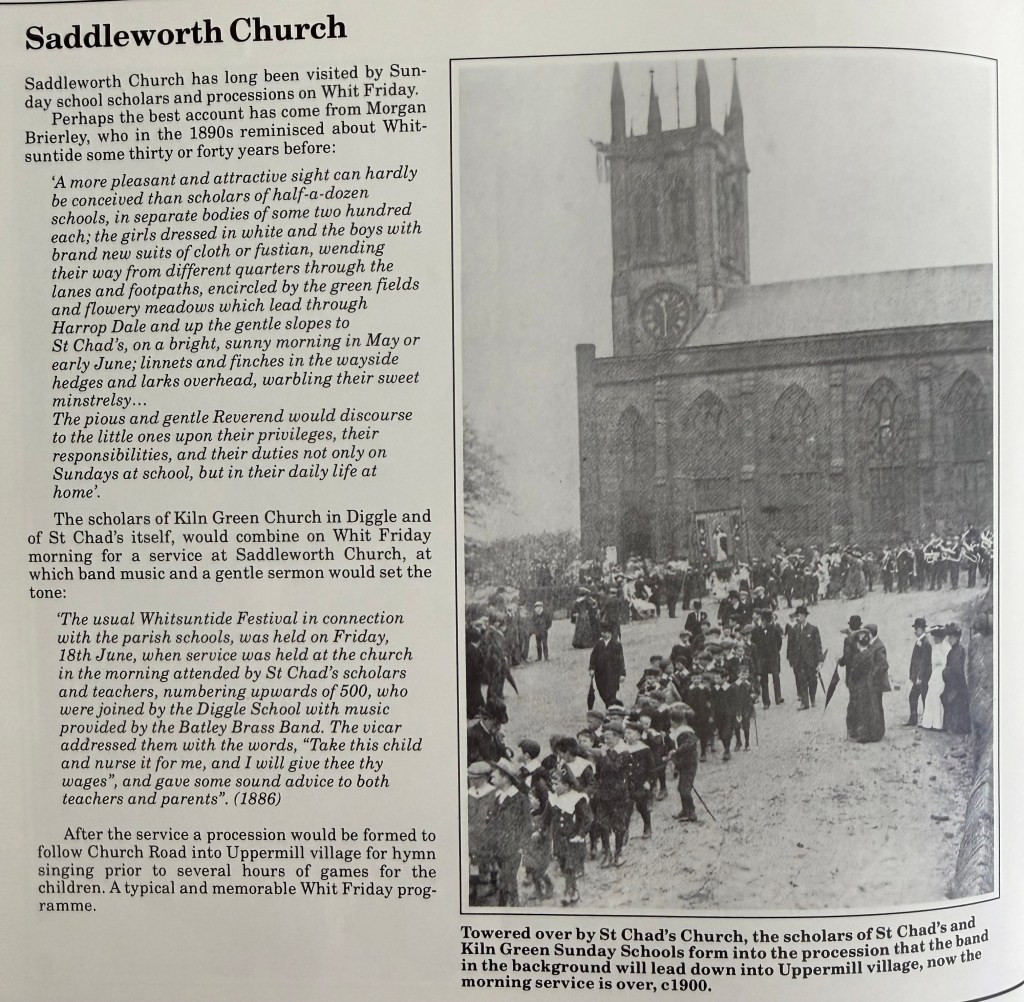
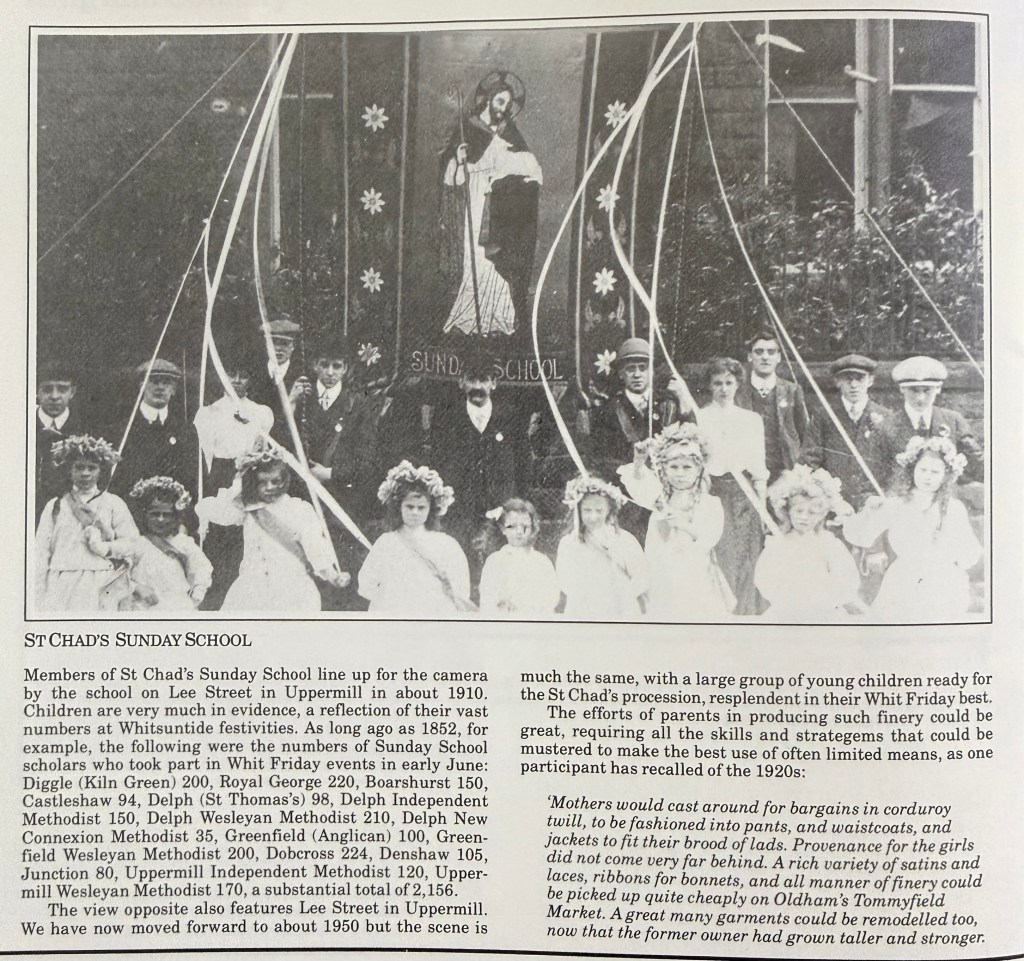
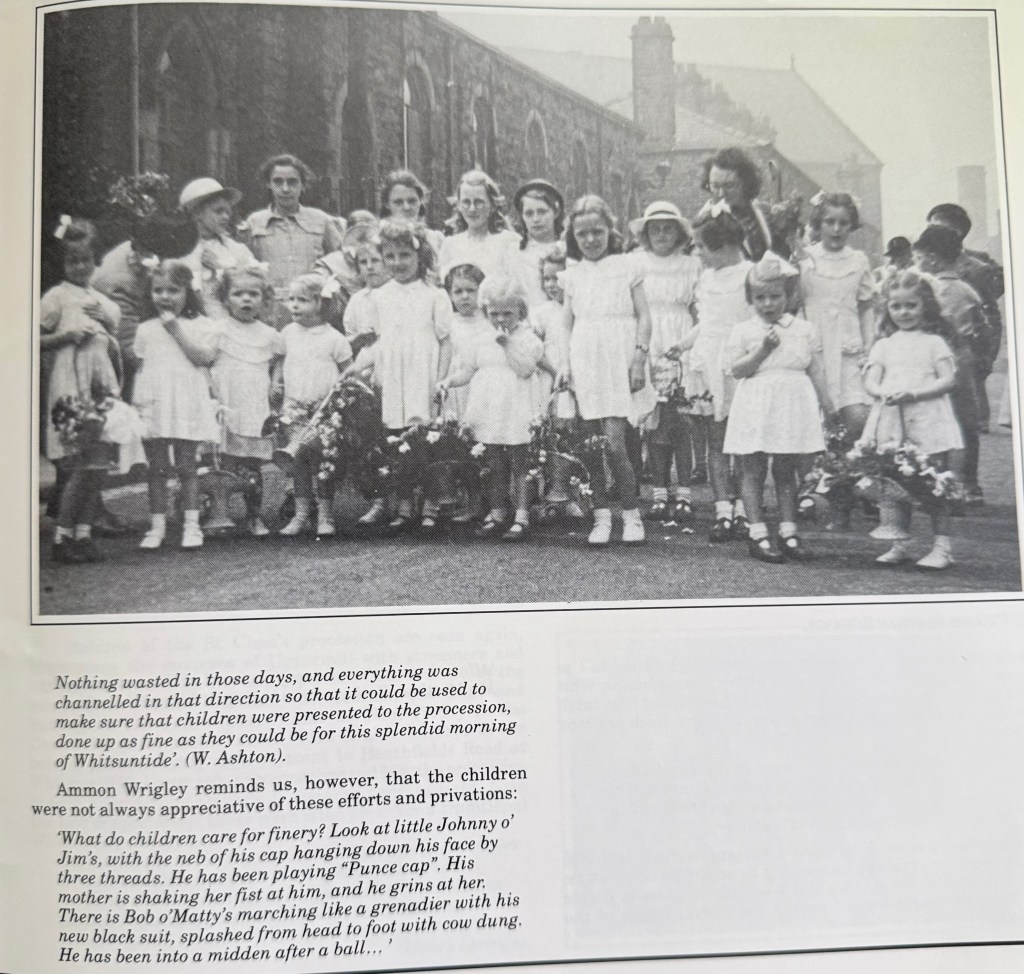
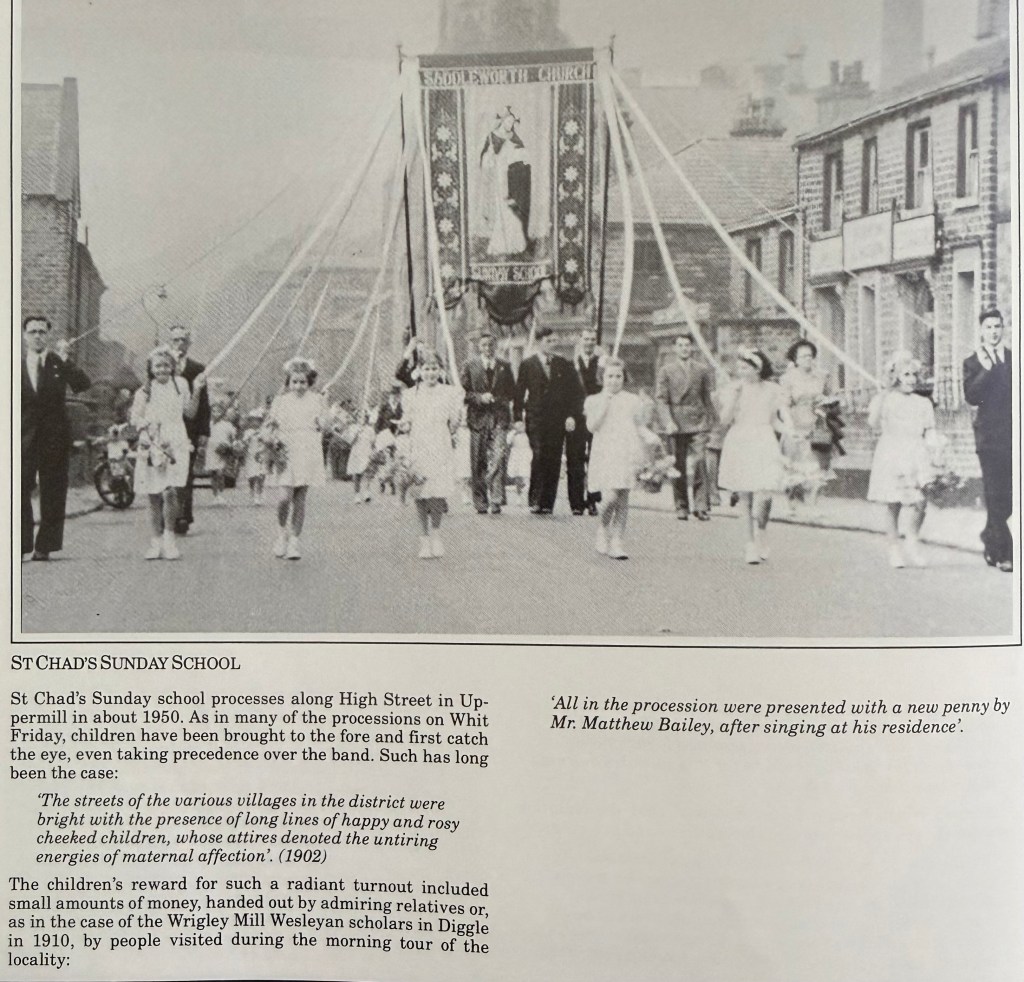
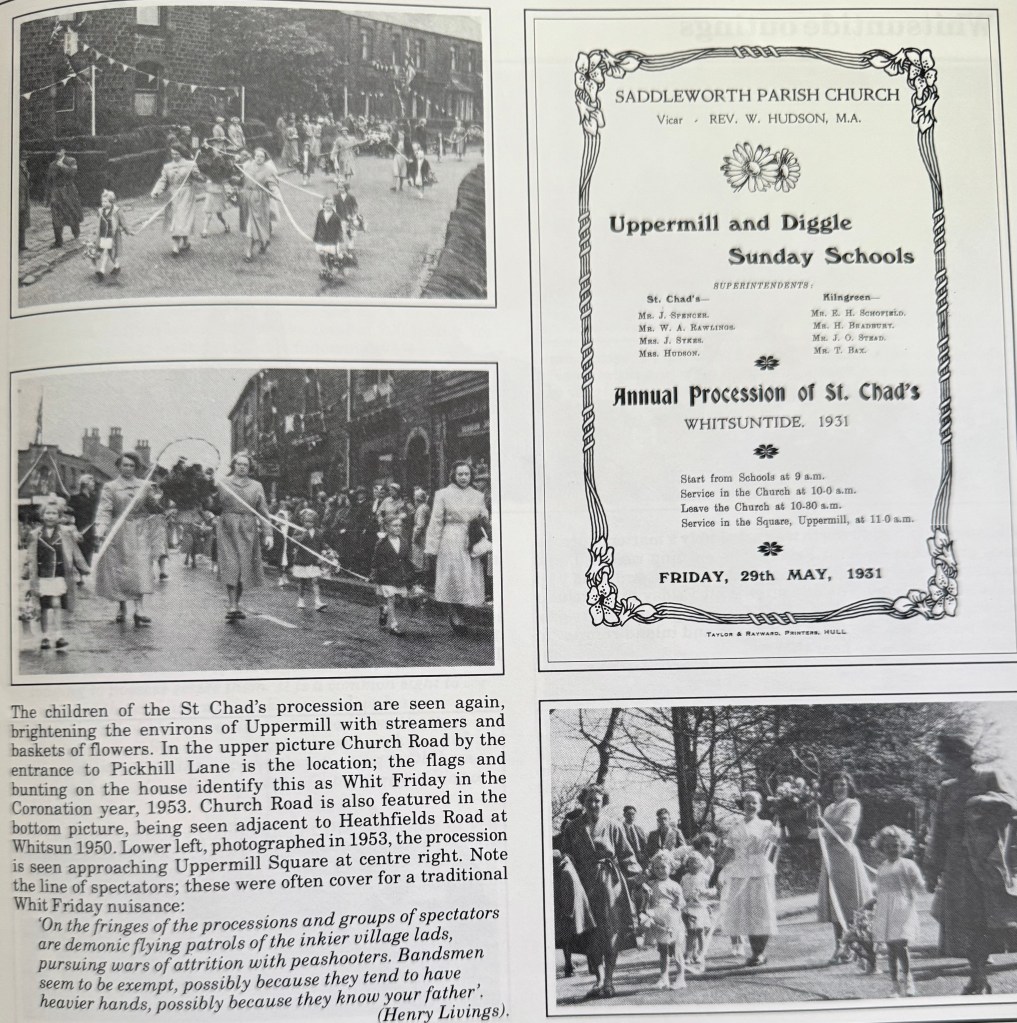
Whit Friday is held as the anniversary of the Sunday schools in the neighbourhood. Early in the morning crowds of children can be seen dressed in their new clothes wending their way to their respective schools where they all assemble, and then led by bands of music, walk in procession with flags and banners to attend service at the place of worship that the school is attached. After service the procession is reformed, and passes through neighbouring villages to the school, where refreshments are provided, at some places consisting of a good substantial dinner of roast beef and plum pudding, and at others current bread and milk or tea. The afternoon and evening are spent in various innocent recreations in which scholars and teachers unite to render Whit Friday all that the children can desire
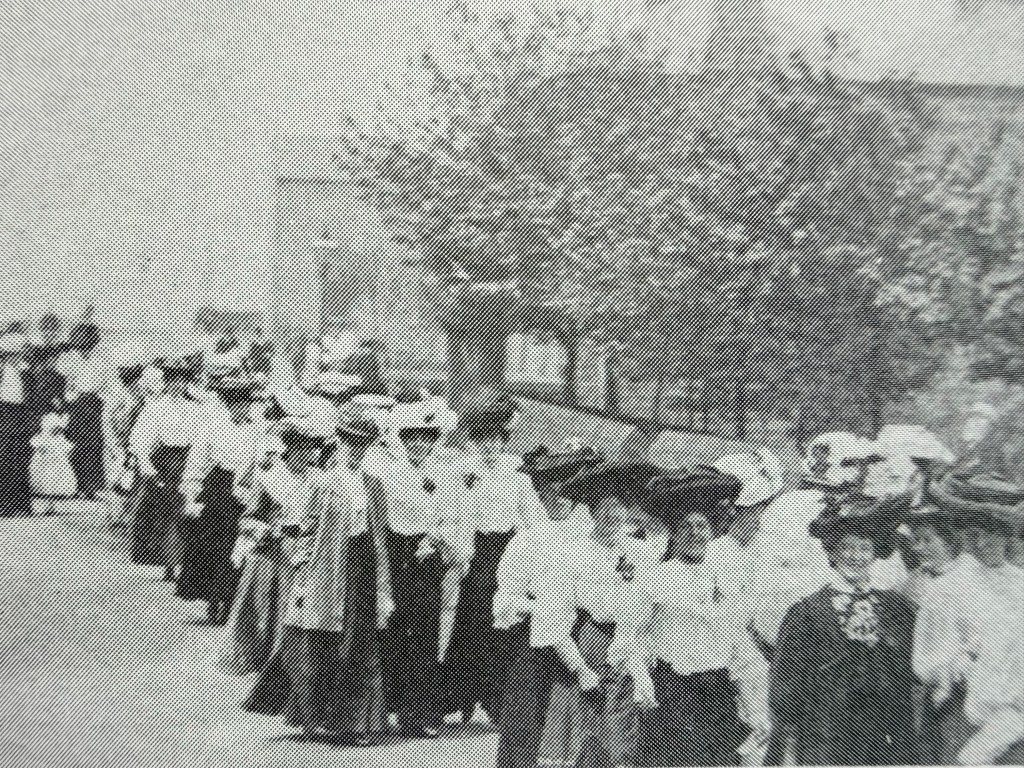
The booklet also says An essential part of all Whit Friday processions is portrayed, the brass band, scholars, best dressed adults from the congregation and a mass of bonneted ladies.
In June 1920, a newspaper reports.
Whit Friday was made noteworthy by a pleasing innovation at Greenfield. The three Sunday schools, St Mary’s, Wesleyans, and Boarhurst, had a united procession which made but one band (The Boarhurst) necessary, and the experiment was voted a great success.
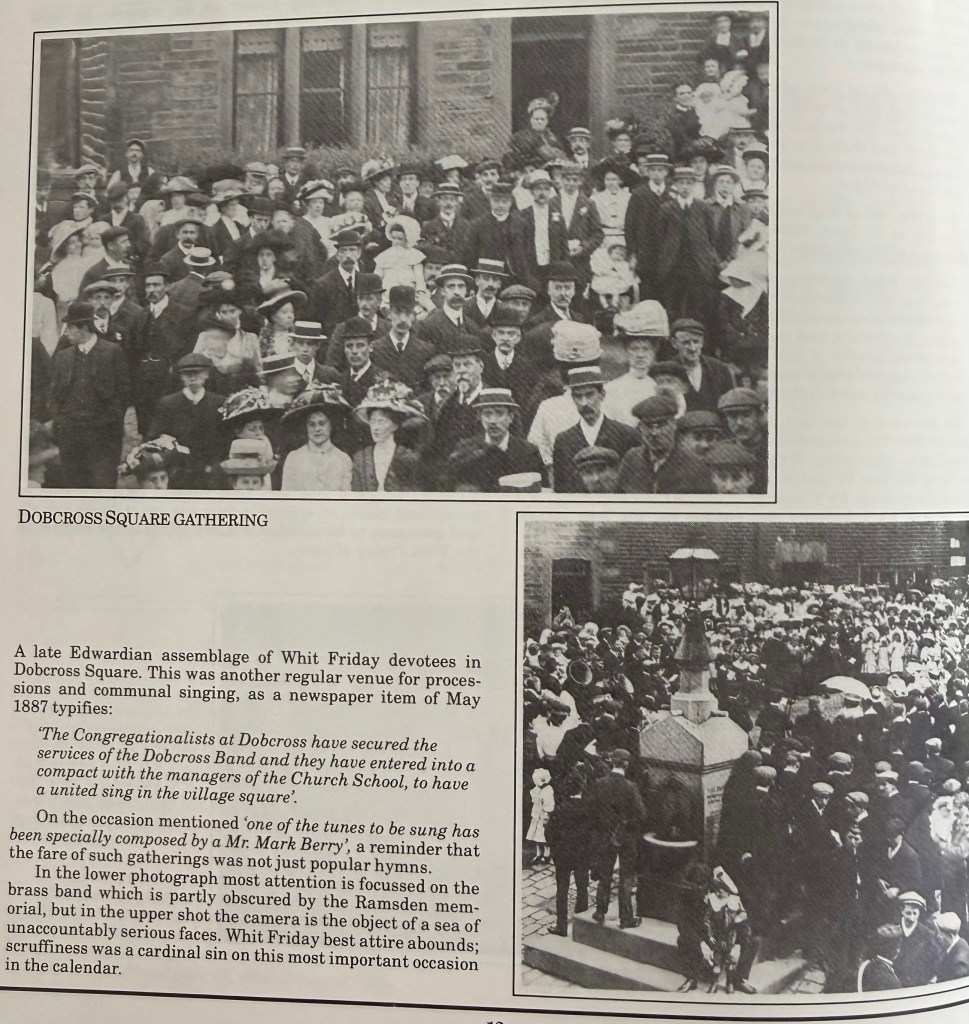
Uppermill Square, also became a focal point for processions to meet up and sing, accompanied by a band. It was only after the first World Ward, a field near St Chad’s House became the safe space away from the increasing traffic of motor cars and charabancs.
To many, Whitsun is about the bands, be they reed, silver or brass. This deep association has grown out of many things not least the competition between local churches, witness to the grandeur of a marching in formation uniformed band. Extremely challenging for the band members carrying and playing their instruments whilst marching up and down the many hills of the area.
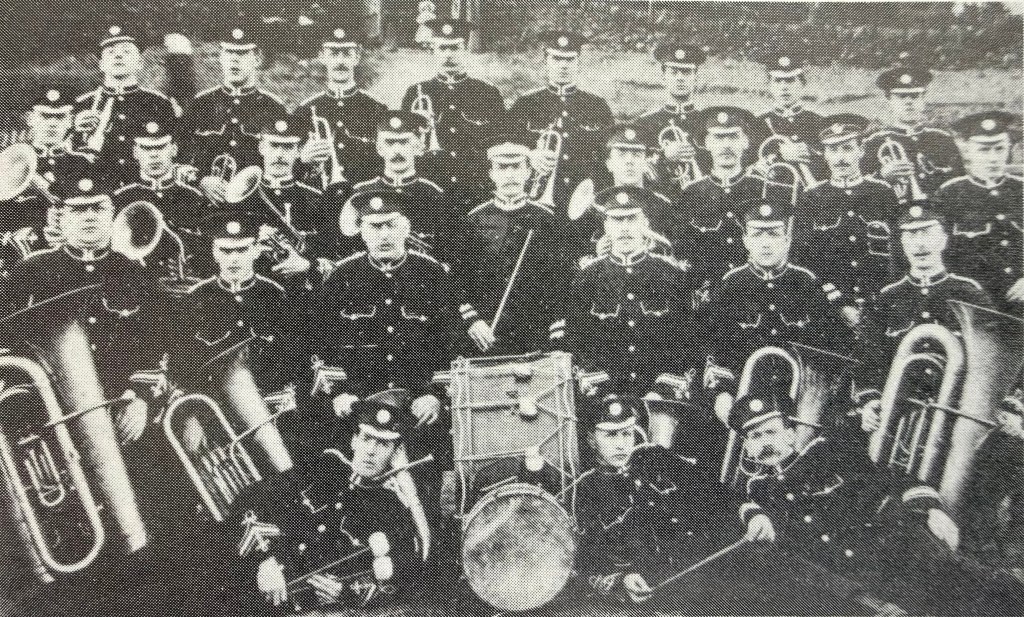
However, the greatest efforts were reserved for the contests. Originating in 1884 in Uppermill, it gave the local and visiting bands a chance to show off their prowess in a more formal way. A pattern was quickly set, with a number of bands, escalating over the years from the initial handful. Playing to a hopefully impartial judge from outside of the area.
In June 1898, 3000 spectators crammed in to Uppermill Square, they stood for 3 ½ hours in the hot evening weather to listen to the ten competing bands. The judges, in which local pride rode on the success of the Saddleworth bands against the interlopers would hide in the upper floor of the “Commercial Hotel’.
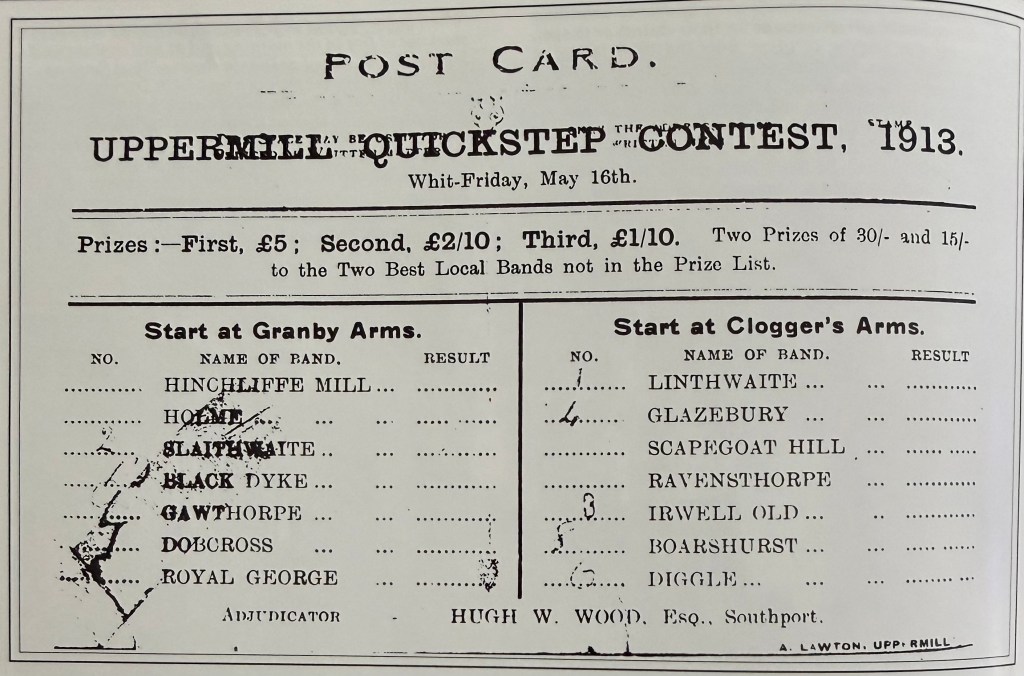
Other contests, came about and it was in Greenfield June 1908 that collecting money for local contests became a thing. In 1909, it was written;
The question being asked if the two band contests on Whit Friday, the one at Greenfield, the other at Uppermill, will tend to “Soothe the savage heart”? With one contest residents have been able to escape by taking a walk into another district, but how are they to escape two? The philosophical will say ‘Grin and abide’, and give cheerfully to any good cause which may be expected to benefit.
1942 as in previous ward years Saddleworth would not be deprived of its Whit Friday. The community were asked to conserve every gallon of petrol.
The whit processions were held as usual at Saddleworth and the children turned out in good numbers. Of course the absence of young men was noticeable, but many elderly men and woman took part and there was no lack of enthusiasm.
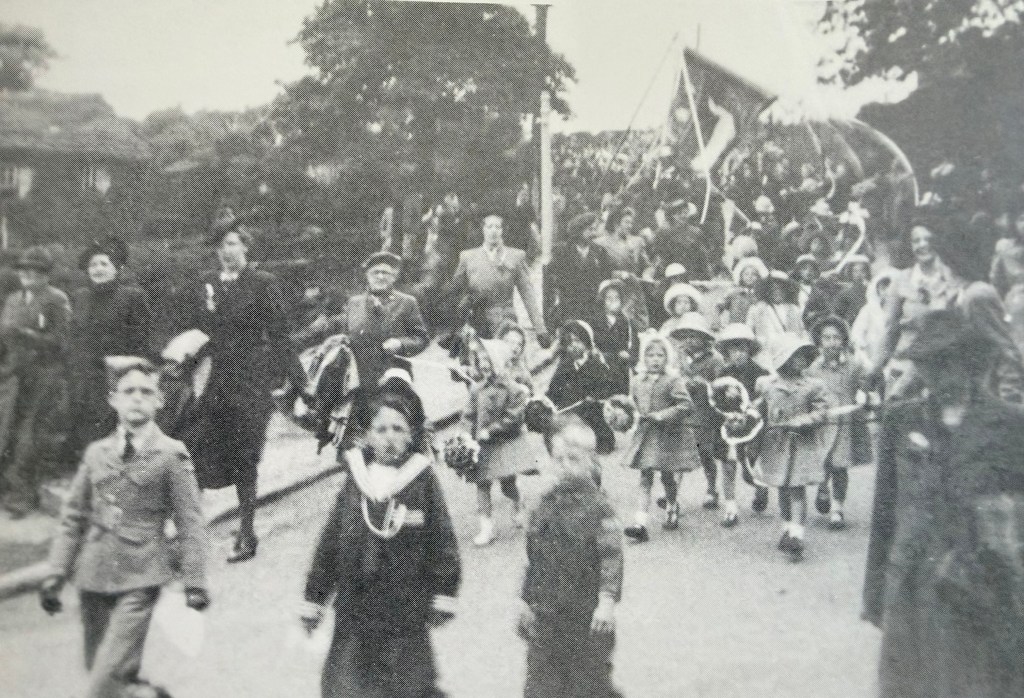
1944 as the banner and procession makes its way down Church Road after the morning service at Saddleworth Church, the children are happy and proud to wear the uniform of their fathers, while the thoughts of their mothers are no doubt overshadowed by world events.
 Historic Saddleworth Church