by Alison Randall
Written by Linda Heley, Mum of Alison about Dorothy Bradshaw.
My mother was a very intelligent lady with a flair for music, mathematics, physics and languages. In 1926, she and her brother built a radio and my Grandfather erected a tall aerial in the back garden so that they could listen in to ‘2 LO: London calling’ and later to transmissions from Sutton Coldfield. The aerial was very strong and sensitive. They were the first people for miles around to have a radio.
During the early 1930s the BBC put out a series of German language programs. My mother was quick to learn and became very fluent. In order to improve her written German, she corresponded with a Jewish lady called Helene Oerrmann who lived in Hanover. The two exchanged letters regularly until 1938. In this letter, Helene gives information relating to her work. When my mother received it, the envelope had been opened and stamped with a Gestapo mark. It seems clear that Helene was engaged in some secret translation work. The letter which is on display (unsure where and when this was FW) was the last letter which my mother received. Although she wrote several times after 1938, all she received were her letters back from Germany, opened, resealed and stamped. My mother believed that gayer this letter was written, Helene was removed to the gas chambers. Nothing was ever received from Helene again.
During the war, the large aerial was camouflaged to look like a tree. A radio set and morse receiver and transmitter were hidden in a cupboard covered by boots and shoes. The house lay under the flight paths from Germany to northern cities. Each evening, my mother put on headphones and listened to the German wavelengths to try to trace information relating to potential raids and Luftwaffe messages. Her fluent German was put to good use to aid the War Effort.
The following is the obituary that was published in Saddleworth Church Parish Magazine April 1991
Dorothy Bradshaw (Dot) was born Dorothy Hill at Kinders Lane, Greenfield 80 years ago. The family house had been built by her grandfather, and she lived there all her life. At first there was father, mother and two older brothers. Dorothy attended St Mary’s Church Infant School, and later Clarksfield Junior School in Oldham. At eleven years of age she passed her scholarship examination to the Hulme Grammar School for Girls. She was a brilliant pupil excelling in English, Latin, and Mathematics. Her ‘star’ subject was Music, she had had piano lessons from an early age, and with natures gift of perfect pitch, she was also an ideal choir member. Her alto voice could keep in tune when all around her were floundering. However, this situation was to alter, for a baby brother had been born whilst she was at the Grammar School, and soon after her mother was bed-ridden with a terminal illness.
With her father and two elder brothers working, and a mother confined to bed, plus the baby brother to care for, Dorothy’s scholastic career came to an abrupt halt. She took over the running of the household at the age of 14. Within a year her mother had died.
Dorothy continued with her music, and in her spare time her great passion was cycling. As a member of the Oldham Cyclists Touring Club, she explored much of the country. With her friend Mary Dyson they set out to explore Southern Ireland by cycle. Together they covered most of the Emerald Isle’s beauty spots, getting as far west as Galway and the Aran Islands.
Her father became choirmaster at St Mary’s and was able to arrange organ lessons for Dorothy. She was soon standing in for the regular organist. When her young brother attended school, she was able to get a job at the local paper mill. At the church, Mr Hill invited a young tenor from Mossley church to take solo parts in the Messiah. The young man was a widower, his name William Bradshaw. Individual soloists rehearsals were held at 1 Kinders Lane, and Dorothy was the accompanist. The young couple soon became firm friends with many interests in common. They became engaged, and were married in 1939. (And So started a very happy and loyal 48 years of married life, blessed with Linda their daughter, and in the course of time a good honest son-in-law Robert, and 13 years ago their granddaughter Alison to make their joy complete.
During the war Bill worked in a local woollen mill, and Dorothy tested shell fuses in a munitions factory. When peace was restored Dorothy gave piano lessons and Bill singing tuition at the Kinders Lane home.
In 1948 Mrs Edith Barnett, the vicar of St Chad’s Wife, asked Dorothy if she would accompany the Church Junior Choir who were to compete in the Saddleworth Eisteddfod. St Chad’s won the shield. Dorothy and Bill were invited to Join the Church Choir starting an association with the worship at Saddleworth Church that lasted for over 40 years. Their friendship with the Barnetts lasted the rest of their lives.
However, their connections with the worship in Greenfield were not severed, for they were able to support the Methodists and their friends and St Mary’s. Dorothy’s beautiful hym tune bears the title ‘Greenfield’
At St Chad’s Dorothy became our organist. With Bill’s assistance she composed an anthem that was subsequently published by Blackburns of Leeds. Latterly she composed a Festival Chorale and Gloria for the handbell ringers to commemorate the 1987 Saddleworth Festival.
Dorothy had a great gift for language. She attended night school and the writing and speaking of German gave her particular pleasure. She was captivated by word and number puzzles, never a day passed without her finishing at least one crossword in her spare moments. She became a regular contributor to the Dalesman magazine with her ‘Yorkshire based’ quizzes. She made a formidable Scrabble opponent. Playing Bowls, and her photography were her summer time hobbies. Many of her colour slides are masterpieces.
In the mid 1950’s seven enthusiastic amateur musicians formed a country dance band. Dorothy was the pianist cum piano accordion player. Along with their two callers the ‘Freebooters’ toured the locality and played regularly for dances in the villages. The distinctive style of playing is still talked about. By this time she had a position with the Oldham Education Authority playing movement and dance in many of the schools. By sharing her expertise with staff and pupils alike she made many lasting friendships. Well into middle age, she continued to take lessons ion the theory and composition of music, and later later used this knowledge to good effect in helping students taking Open University courses in these subjects. It is fortunate that her musical talents have been handed down to Linda and Alison.
Both she and Bill were regular members and took an active part in the administration of the local retired people’s forum.
When her illness kept her housebound she appreciated the visits of friends and neighbours who found her so cheerful and brave in spite of her suffering. Latterly her visits to the Hospice at Dr Kershaw’s were the highlights of her remaining weeks. Words are not adequate to tell of the joy and happiness she received from the nurses, staff and patients too. She missed her church worship, however, the Rev. Phillip’s frequent visits were of great comfort to her. Two friends, one form the Hospice and one form Church took over from Linda and her friend Susan at the Hospital bedside, and were with her at her passing. Such a courageous Christian. She will be sadly missed for she gave so much to so many. JRW
Alison notes that the obituary mentions Dorothy’s travels in Ireland. These were serialised in the Oldham Standard Supplement newspaper in 1935 – 1936. Her composition ‘Greenfield’ won 1st prize in the 1951 Mrs Sunderland festival. She won a guinea. The tune was dedicated to Markham Main Colliery Band, who had close Whit Friday connections with Greenfield Methodists. In the Freebooters Band, which she formed jointly with Alan Roughly, she played accordion. She also composed another prize winning anthem, for SATB voices, for the Brighton Music Festival in 1949.
The following obituary is for Alison’s Grandad, George William Bradshaw (Bill) which was published in the Saddleworth Church Parish Magazine October 1987.
George William Bradshaw (13/03/1904 – 10/09/1987) (Bill to his friends) died peacefully in his 84th year on September 10th. He was born in Mossley and knew the meaning of hard times from a very early age. His father died when Bill was 4 and as soon as he could run errands he helped to support his impoverished mother, brother and baby sister.
He attended Mossley Brow School and at noon every day he raced down the hillside to his cottage home in the valley to deliver the hot dinners his mother had cooked for mill-working relatives and friends. There was hardly time for him to eat before he was panting up the hill back to school. There was a regular ritual as Headmaster Ousey confronted the belated boy with the cane.
This fell running developed his lungs and the cane’s customary tattoo beat a sense of rhythm into the lad, two most useful assets when he joined St George Parish Church Choir at the age of 9. So began a love of Choral music that continued ¾ of a century.
At the age of 12 he started half time work at lawton’s Woollen Mill in Micklehurst. This was during the First World War and the demand for Khaki Cloth was such that the mill day started at 6:30 am. At noon as ever, Bill raced down the slope, though now it was the opposite hillside, to deliver the home cooked dinners then plod up to Mossley Brow to confront the Headmasters cane. It was a struggle to keep his eyes open as Mr. Ousey droned on to class X7.
From his earning money was set aside for singing lessons, and his lead in the tenor pew was noticed at the age of 18 he became choirmaster. In spite of toes crushed when he was a baby he became renowned as a budding sportsman soccer and cricket teams. He was a goalkeeper for Mossley Brow Football Club.
During the years between the two World Wars his life was full of ups and downs. Unemployment was rife, but Bill could turn his hand to anything in the textile trade. It became almost a pleasure to be in work, walking bare foot behind a pair of spinning mud frames, tending the vital threads. Backwards and forwards thousands of times per shift to cover a distance of 12 miles a day! Mentally he would be miles away, happily trilling his Handel or mastering the counterpoint of his beloved Bach. Then would come another slump and the job was at an end.
Bill scoured the area for work and at the outbreak of World War 2 he was employed in Greenfield as Waterman with the Ashton Authority. He was one of the original Dad’s Army recruits, wearing an armband that proclaimed L.D.V (Local Defence Volunteer) and guarding Yeoman reservoir with a hefty walking stick!
Bill had good fortune to meet Dorothy Hill, a Greenfield girl with interests similar to his own. They fell in love and were married in 1939 and set up home at 1 Kinders Lane. Linda their daughter was born in 1940.
With Dorothy’s help his musicianship really took off. He joined local musical societies, good tenor voices were in demand. Attracted by the reputation of Mr. Albert Hardie the choirmaster at St.Chad’s, Dorothy and Bill joined the Parish Church Choir in 1948. A few years later Dorothy became organist, mastering the complications of an early Hammond Console. Encouraged by friends in the Church Choir Bill attended for audition and became a member of the Halle Choir. Under the direction of Sir John Barbirolli’s baton, his musical experiences scaled new heights.
With a keen interest in drama as well as singing, Bill’s leisure time was fully booked. However, at the age of 65 he took driving lessons and soon passed his test. He continued to be a competent motorist right up to his final illness.
For his granddaughter he tape recorded the works of our local poets Ammon Wrigley and H.B.Whitehead. His unaccompanied singing of Delph Show is a gem. It was partly at his instigation and encouraged by his enthusiasm that our recent Choir Tape came into being, and already it is becoming a collectors item.
Bill loved flowers and grew lovely blooms in his small back garden. However, his last request (thinking as ever about other people) was a family wreath only when he died. ‘If people want to remember me, I’d sooner the money went to benefit deaf children and folks like me with a wonky heart” His request will be fulfilled.
In our journey through life, we come across thousands of people but it has been a privilege to meet and know a man as great as Bill Bradshaw. We shall miss him JRW
Alison adds, that she has the recordings from 1947 of his singing and Granny playing the piano recorded in Ashton-Under-Lyne. Although she does not have the tapes of his recorded poetry, she does have some original documents in Ammon Wrigley’s writing.
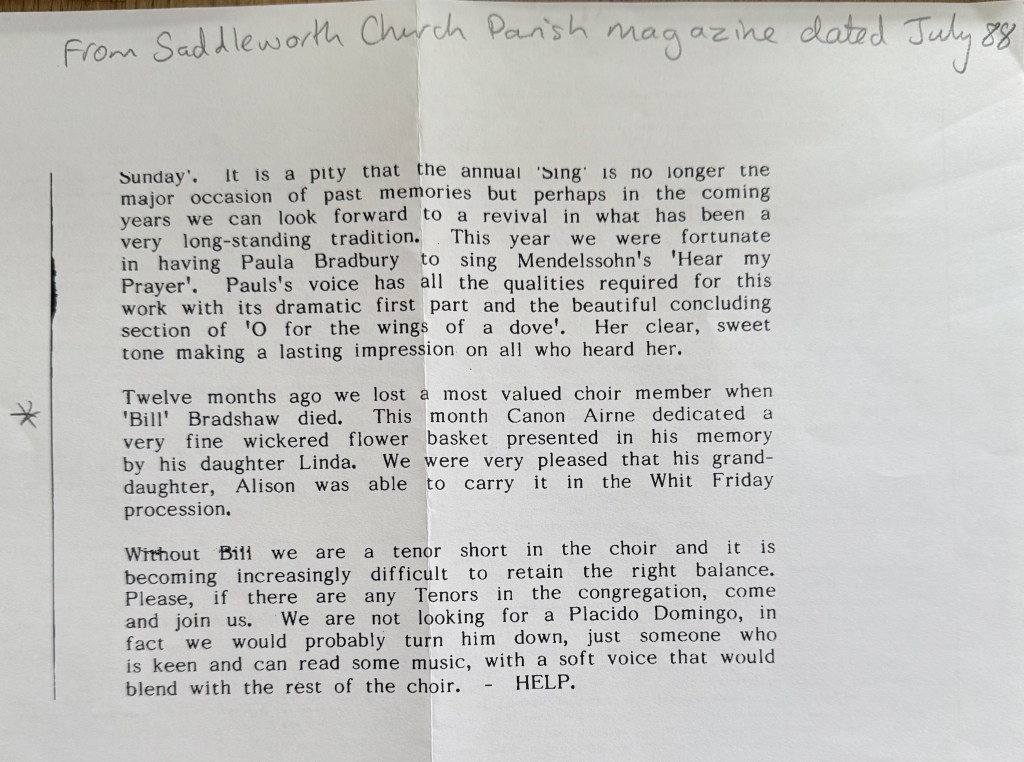
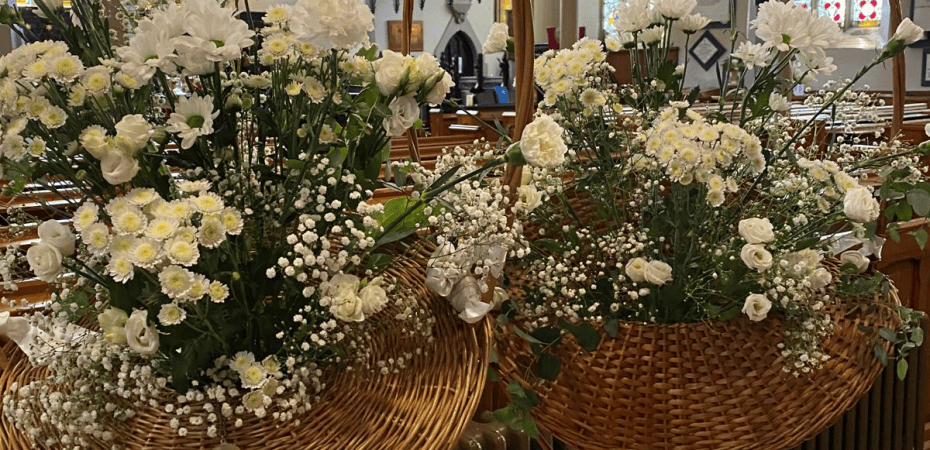
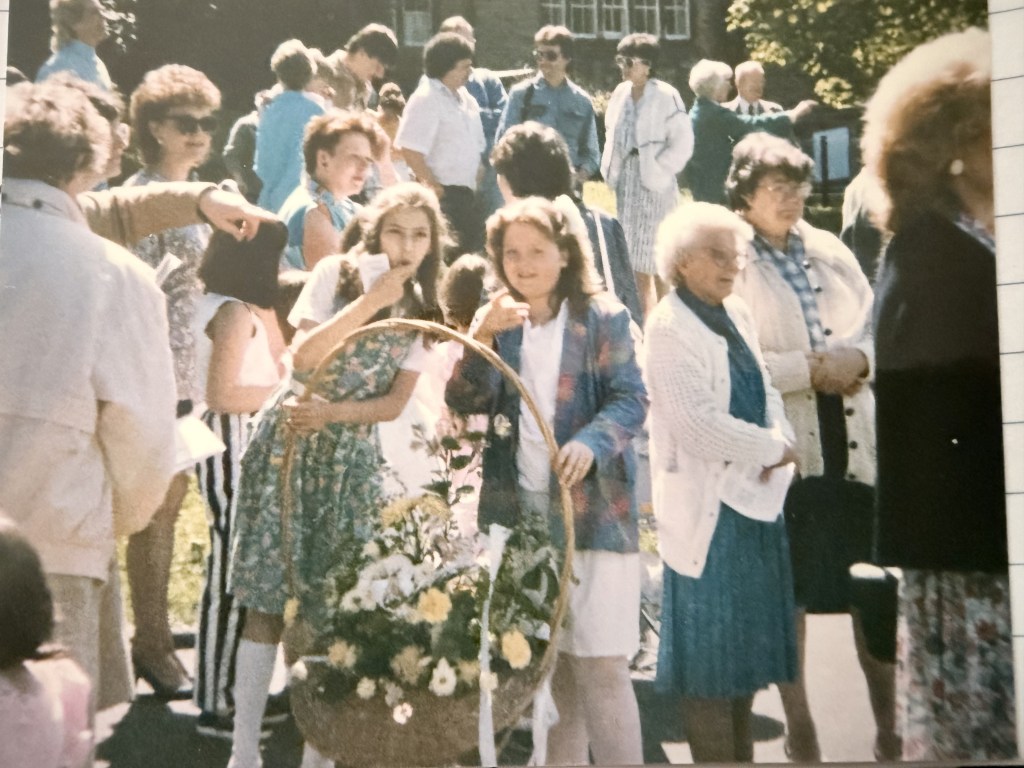
24th June 2013, Linda wrote a letter to the Editor of Saddleworth Independent. Thanking them for a picture of the Whit Friday baskets, which were presented to Saddleworth Church in memory of her parents. Bill’s basket was made by a blind basket maker. Bob Hedges. Who lived in Olney, Buckinghamshire. Noting that her father sang in the church choir for 41 years, the day before Lord Rhodes. That her mother played the organ for 22 years. She died on St Chad’s day.
Linda also discusses, that her great-grandfather, James Bourne, was involved in the construction and maintenance of several buildings in Saddleworth including Greenfield Methodist and Friezland, also Boarhurst School, now an activity centre, where he was superintendent of the Sunday School for many years. James was a Monumental Mason too, many of his monuments are to be seen in the local churchyards.
James Bourne’s predecessors. Thomas Bourne, known as the Standedge Admiral, and John Bourne (James’s Father) were involved in the building and working of the Huddersfield Narrow Canal and Standedge Canal Tunnel. John Bourne was a steam beam-engine engineer and family research suggests that he learned his trade from James Watt at Matthew Boulton’s Factory in Birmingham.
Reflections, written by Linda before her death. Linda was born late in the afternoon of 4th October in a maternity hospital which was next to the Barracks. WW2 was not a time of peace, especially with the Barracks next door and Manchester just a few miles away, that night there was an Air-raid.
Linda was the only child of Bill and Dot Bradshaw and soon, she was taken home to Saddleworth to live in the house built by her great-grandfather. She lived with her parents and grandfather. In less than two months after her birth, she caught Whooping Cough, a very serious illness in one so young and the consequences from this illness, were life long. As a young child, Linda was not healthy. Life was hard; food and coal were rationed and the house was cold. Linda had memories of sitting beneath the large square dining table whilst her mother, a fluent German speaker, sat with headphones on doing her bit for the war effort. In 1947, during an exceptionally cold, blizzard winter, the snowdrifts reached the bedroom windows and the milkman tied horse, which was pulling a sledge, to the top of the lamp post.
Both parents were very capable musicians and when the war ended, her father gave singing lessons to friends and her mother had piano pupils. Her mother became the organist at the Parish Church. The house was full of music every night and it was impossible to sleep. Linda was taught to sing and play the piano when she was 5. In the summertime, she loved to roam onto the nearby hillside and lie watching the hares tumbling down the hill or the skylarks falling from the sky in to their nests in the heather.
At age 11, Linda passed her 11 plus exam and won a placement at Hulme Grammar School for Girls, in Oldham. As well as core subjects, which included Latin, she studied composition and musical arrangement with Mr. Noel Walton, brother to the composer, Sir William Walton and eventually, on leaving school at 18, went to Sheffield to train as a teacher. At this period of time Linda auditioned for placement in the Sheffield Philharmonic Chorus, and she was accepted in to the Soprano section. It was at this time too, that she suffered her first Heart Attack following a Geography field climb up Snowdon, going into cardiac arrest at just 21.
Linda taught in the north of England (Derker Junior 1963-1969) for 6 years before moving south, to teach in a residential School (Great Harwood) ore children with special needs. It was at this time that she joined the Blue Mountain Band who played mostly, in London and the suburbs. They became a regular group to play at Cecil Sharp House, the headquarters of The English Folk Dance and Song Society. This was very much a highlight period as Linda played for the O’Sullivan Irish Dancers in the Royal Albert Hall, sequence dancers rather similar to Riverdance. Subsequently, she wrote and arranged overtures and dance music, for the English Folk Dance and Song Society’s Festival at the Royal Albert Hall on two separate occasions, in 1972 and 1981.
It was whilst the band was playing at Sidmouth Festival that Linda met Robert, they were married at St Chad’s Church, Saddleworth and set up home in Newton Longville, Buckinghamshire, where Robert was a teacher in a local school. Linda stayed home whilst Alison, their only child was little, but there were frequent visits north, to visit Alison’s grandparents and to Stewkley, in Buckinghamshire to see Grannie Heley. In 1986 when Alison had passed the exam to the Prep dept of Dame Alice Harpur School (now Bedford Girls School) the family moved to Wilstead and Linda began a new job with an egg company, as a merchandise supervisor. This necessitated driving vast distances in England and in the first year alone, she had driven over 47 000 miles. This job ended abruptly following the Salmonella scare so Linda took a new role at Foster Hill Road Cemetery, working part time but spending one morning a week attending to the flower arrangements at Norse Road Crematorium.
For Linda the highlight of every year, was Whit Friday, when all the churches in Saddleworth meet and hold processions of witness, with parishioners following their church banner and singing hymns on their way to a combined service in the park at 11 am. This Friday is always 2 days before Trinity Sunday and it is a moveable feast day.
This was Linda’s time for religious renewal and she maintained her pilgrimage back to Saddleworth until further, serious heart problems occurred in 2014, making the journey north all, too taxing. However, in 2023, when very disabled, she found processions had been placed on Youtube, much to her joy, so she was able to watch from the comfort of an arm chair.
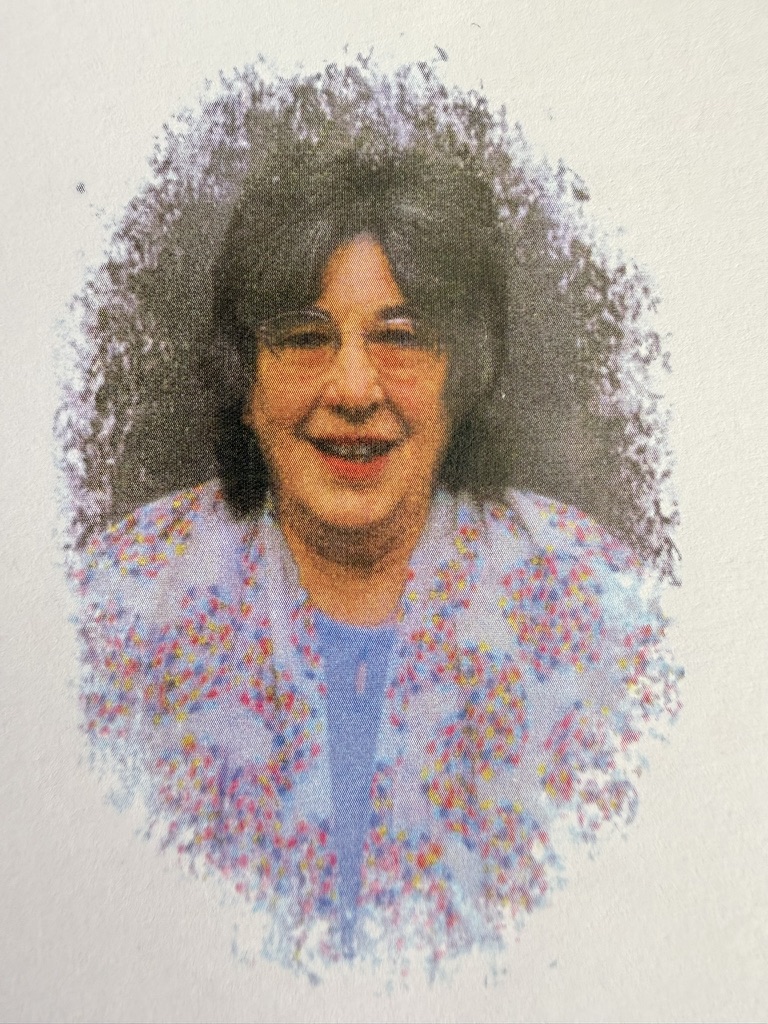
Alison notes, that Linda went to Huddersfield first from 1959-1960 then to Sheffield 1960-1963. That the egg company was Thames Valley. That Blue Mountain Band, recorded tracks in 1972, 1973, 1977 and 1980. For the 1977 record, Linda was 8 ½ months pregnant and did two consecutive all-nighter weekends. Apparently Alison was kicking mercilessly when they got to a particular bit, which they had to retry several times. I came along ten days after the second of those weekends. They also recorded for Radio Oxford, Most of the bands recordings only went onto the internet for the first time in March 2024, a young enthusiast out them up. The archive can be found at www.thomasbending.co.uk/bmb/index.php (mum wrote most of this material)
A big thank you to Alison for sharing her mums and grandparents stories.
 Historic Saddleworth Church